
May 4
Dignity of Risk in Aged Care: Supporting Resident Choice While Managing Infection Risk
A Practical Guide for Care Teams in Australia and New Zealand
Dignity of risk is one of the most important — and most misunderstood — principles in aged care. Under Australia's Strengthened Aged Care Quality Standards (effective November 2025) and New Zealand's NZS 8134:2021, residents have an explicit right to make their own choices, including choices that carry risk. This blog explains what dignity of risk means in practice, how it applies to infection prevention decisions, and how aged care teams in Australia and New Zealand can honour resident choice while managing risk responsibly and documenting it correctly.
A practical guide for the aged care team in Australia and New Zealand on supporting
resident-led decisions — including infection and safety risks — without losing sight of
dignity.
Aged care has always lived with a quiet tension. We are responsible for keeping
residents safe and honouring their right to live as they choose. Most days, those two
priorities sit comfortably together. Some days, they don’t — and that’s when our
practice is truly tested.
From 1 November 2025, the Strengthened Aged Care Quality Standards took effect in Australia, and Standard 1 places the dignity of risk where it belongs - at the heart of how we treat older people. New Zealand’s Ngā Paerewa Health and Disability Services Standard (NZS 8134:2021) has been conveying the same message since 2022 - residents have the right to make their own choices, including choices that carry risk.
For aged care teams, this is not a minor adjustment. It is a cultural shift. We are moving away from a reactive, risk-averse mindset that quietly erodes choice in the name of safety, and towards a proactive, person-led approach where the resident’s voice leads — and our role is to make that choice as safe as is reasonably possible.
From 1 November 2025, the Strengthened Aged Care Quality Standards took effect in Australia, and Standard 1 places the dignity of risk where it belongs - at the heart of how we treat older people. New Zealand’s Ngā Paerewa Health and Disability Services Standard (NZS 8134:2021) has been conveying the same message since 2022 - residents have the right to make their own choices, including choices that carry risk.
For aged care teams, this is not a minor adjustment. It is a cultural shift. We are moving away from a reactive, risk-averse mindset that quietly erodes choice in the name of safety, and towards a proactive, person-led approach where the resident’s voice leads — and our role is to make that choice as safe as is reasonably possible.
What does “dignity of risk” mean?
Risk in aged care is multi-layered. It includes physical harm, nutritional compromise,
emotional distress, and — increasingly — infection risk. Dignity of risk does not
mean ignoring or minimising these risks. It means recognising that the resident’s
informed choice sits alongside our obligation to identify, explain, and manage them
as effectively as possible.
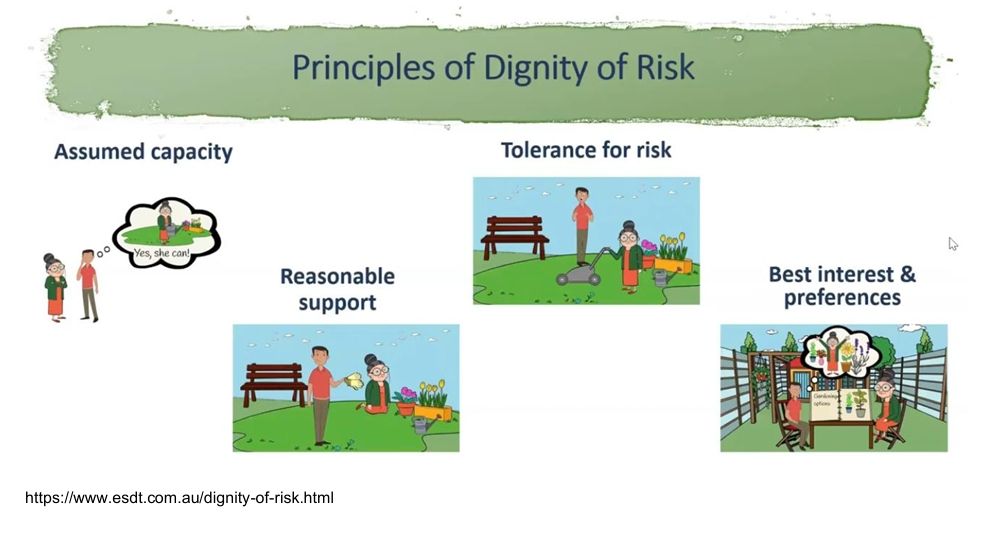
Dignity of risk is the principle that older people have the right to live as they choose, even when those choices involve the possibility of harm. It reflects a simple truth: a life with no risk isn’t really a life.
Dignity of risk is the principle that older people have the right to live as they choose, even when those choices involve the possibility of harm. It reflects a simple truth: a life with no risk isn’t really a life.
In a residential aged care facility (RACF), this might involve a resident who:
- Refuses isolation or PPE use during a suspected infection episode
- Wants to keep walking unassisted, despite a recent fall
- Prefers their evening whisky over the dietitian’s recommended fluids
- Chooses to receive visitors during heightened respiratory virus risk
- Chooses to share a bed with their long-term partner
- Wants to keep eating their favourite foods, despite a swallowing risk
These aren’t failures of care. They are acts of personal choice, and the current
standards explicitly protect them.
What do the standards say?
The Strengthened Aged Care Quality Standards, Standard 1: The Individual,
recognise dignity of risk as a core right. Older people are recognised as having
autonomy and are free to live as they choose, make informed decisions, and
exercise dignity of risk. Providers are expected to support residents to understand
the risks associated with their choices and how those risks might be managed — not
to override choice simply because it feels uncomfortable.
In New Zealand, Ngā Paerewa is equally clear. Residents have the right to refuse treatment, withdraw consent, and be fully informed of alternative options. Choice is framed as a Te Tiriti-aligned, person- and whānau-centred right, not a privilege granted at the discretion of the service.
Infection prevention and control is often where dignity of risk feels most challenging. When infection risk increases — during outbreaks, seasonal illness, or periods of heightened vulnerability — teams can feel pressure to default to restriction, isolation, or enforced compliance.
The strengthened standards do not remove our responsibility to prevent infection. They do, however, require IPC measures to be applied proportionately, transparently, and in partnership with the resident wherever possible. This means explaining risk, exploring alternatives, and documenting informed consent or refusal — not automatically substituting resident choice with blanket rules.
IPC-related restrictions should be clinically justified, time-limited, regularly reviewed, and implemented using the least restrictive approach available.
Both frameworks ask the same thing of us: respect the person, support the choice, manage the risk, and document the process thoroughly.
In New Zealand, Ngā Paerewa is equally clear. Residents have the right to refuse treatment, withdraw consent, and be fully informed of alternative options. Choice is framed as a Te Tiriti-aligned, person- and whānau-centred right, not a privilege granted at the discretion of the service.
Infection prevention and control is often where dignity of risk feels most challenging. When infection risk increases — during outbreaks, seasonal illness, or periods of heightened vulnerability — teams can feel pressure to default to restriction, isolation, or enforced compliance.
The strengthened standards do not remove our responsibility to prevent infection. They do, however, require IPC measures to be applied proportionately, transparently, and in partnership with the resident wherever possible. This means explaining risk, exploring alternatives, and documenting informed consent or refusal — not automatically substituting resident choice with blanket rules.
IPC-related restrictions should be clinically justified, time-limited, regularly reviewed, and implemented using the least restrictive approach available.
Both frameworks ask the same thing of us: respect the person, support the choice, manage the risk, and document the process thoroughly.
Sources: Strengthened Aged Care Quality Standards (Aged Care Quality and Safety Commission, effective 1
November 2025); Ngā Paerewa Health and Disability Services Standard NZS 8134:2021 (Ministry of Health NZ, 2021).
What about when we don’t agree with the choice?
This is the hardest part — and it deserves to be said out loud. Sometimes a resident
will make a choice that the care team finds genuinely difficult to support. The choice
may increase fall risk, worsen a chronic condition, or shorten life expectancy. Our
clinical instincts surface, and the urge to protect, persuade, or intervene is strong.
Dignity of risk asks us to pause. It reminds us that the resident — not the facility, not the family, and not the clinical team — is the author of their own life. Our role is not to remove risk, but to ensure the resident understands it, has access to relevant information, and is supported to live with the consequences of their decision.
Disagreeing is not disrespectful. Clinical concerns can be documented, alternatives offered, and escalation to the GP undertaken — while still honouring a resident’s right to choose. What we cannot do, and what the standards explicitly caution against, is quietly restricting, withholding, or overriding choice simply because it makes us anxious.
Dignity of risk asks us to pause. It reminds us that the resident — not the facility, not the family, and not the clinical team — is the author of their own life. Our role is not to remove risk, but to ensure the resident understands it, has access to relevant information, and is supported to live with the consequences of their decision.
Disagreeing is not disrespectful. Clinical concerns can be documented, alternatives offered, and escalation to the GP undertaken — while still honouring a resident’s right to choose. What we cannot do, and what the standards explicitly caution against, is quietly restricting, withholding, or overriding choice simply because it makes us anxious.

Scenario: Mr Jones and his visitors
Mr Jones is 82 and lives in a residential aged care facility. There is an increase in
respiratory illness in the community, and the service has implemented heightened
IPC precautions, including visitor screening and recommendations to limit
non--essential visits.
Mr Jones understands the increased infection risk but chooses to continue seeing his family each week. He tells staff that these visits are essential to his wellbeing and mental health, and that isolation during previous outbreaks was deeply distressing for him.
The team is concerned about the potential risk to Mr Jones and to others in the home. A purely risk-averse response might be to strongly discourage the visits, apply blanket restrictions beyond the current guidance, or frame the visits as “not allowed right now.”
Mr Jones understands the increased infection risk but chooses to continue seeing his family each week. He tells staff that these visits are essential to his wellbeing and mental health, and that isolation during previous outbreaks was deeply distressing for him.
The team is concerned about the potential risk to Mr Jones and to others in the home. A purely risk-averse response might be to strongly discourage the visits, apply blanket restrictions beyond the current guidance, or frame the visits as “not allowed right now.”
A dignity-of-risk approach looks different:
- The team sits with Mr Jones to understand what the visits mean to him and what he fears losing if they stop
- IPC risks are explained clearly and honestly, including how respiratory infections spread and who may be most vulnerable
- Risk-mitigation strategies are discussed collaboratively: symptom screening before visits, hand hygiene on arrival, limiting visits to one area, and avoiding visits during times of peak illness
- Mr Jones confirms that he understands the risk and wishes to proceed
- The discussion, agreed controls, and review points are documented in his care plan
- The plan is communicated to all staff, so responses are consistent and respectful
Mr Jones continues to see his grandchildren. The infection risk has not been ignored
— it has been managed thoughtfully, transparently, and in partnership with the
resident.

Scenario: Mrs Henderson and her morning walk
In another wing; Mrs Henderson is 89, has osteoporosis, and fell three weeks ago.
She’s now insisting on her morning walk to the garden, unaccompanied, as she did
before the fall. The team is concerned.
A reactive response would be to discourage her, walk her there ourselves every time, or quietly stop offering the option. A dignity-of-risk response looks different:
A reactive response would be to discourage her, walk her there ourselves every time, or quietly stop offering the option. A dignity-of-risk response looks different:
- Sit with Mrs Henderson and ask what the walk means to her
- Share the clinical information honestly - what changed after the fall and what could happen
- Offer practical risk-management options: a walking aid, a check-in time, hip protectors, and a safer route
- Document the conversation, her decision, and the agreed plan in her care plan
- Communicate the plan to the whole team so everyone consistently supports it
Mrs. Henderson is still walking to the garden. The team is still concerned, but the worry is held alongside her choice, not used to override it.
What does this mean for your team?
Dignity of risk is everyone’s responsibility, not just the clinical team. Lifestyle staff,
care workers, kitchen teams, cleaners, and volunteers all either strengthen a
resident’s autonomy or chip away at it.
Practical things every team member can do:
- Ask before acting. “Would you like me to help, or would you prefer to do it yourself?”
- Listen for the choice beneath the behaviour. A “no” is information, not a problem to solve.
- Use IPC practices as shared safety tools, not punishments or bargaining chips.
- Bring concerns to the team meeting, not to the resident’s ear.
- Document conversations about risk, not just incidents.
Treat family input as input - the resident’s voice still leads.

Take-home message
The new standards are not asking aged care teams to be reckless. They are asking
us to be brave enough to let residents remain the experts in their own lives. Risk
does not disappear when choice is removed — it simply shifts to quality of life, trust
in the service, and a person’s sense of dignity and identity.
Honour the choice. Manage the risk. Document the conversation. Trust your team to hold concern and respect at the same time.
That is what dignity of risk looks like in 2026.
Honour the choice. Manage the risk. Document the conversation. Trust your team to hold concern and respect at the same time.
That is what dignity of risk looks like in 2026.
Sources: Strengthened Aged Care Quality Standards — Standard 1: The Individual (Aged Care Quality and Safety
Commission, effective 1 November 2025); Ngā Paerewa Health and Disability Services Standard NZS 8134:2021
(Ministry of Health NZ, 2021); Sector Guidance for Ngā Paerewa Health and Disability Services Standard NZS
8134:2021 (Ministry of Health NZ, 2021).
For more blogs, see the HUB
That tricky question? Ask EVE for a quick answer or talk to our team at support@infectioncontrol.care
Lyndon Forrest
Managing Director | CEO
Lyndon is the Managing Director of Infection Prevention Services (IPS), bringing over 30 years' experience supporting aged care providers across Australia and New Zealand.
With a background spanning outbreak response, compliance, and infection risk management — alongside hands-on experience leading teams, managing multi-site operations, and navigating business turnaround — he understands both the clinical and organisational pressures aged care providers face. Lyndon holds a Master of Commerce (Industrial Relations), and applies that foundation to the people, process, and growth challenges that come with running a complex healthcare services business.
He is passionate about building the systems and capability that make infection prevention sustainable — not just compliant — and about helping organisations grow their confidence alongside their practice.
Lyndon's focus is straightforward: strengthen operations, develop the right people, and drive proactive infection prevention strategies that protect residents, staff, and communities for the long term.
Lyndon is the Managing Director of Infection Prevention Services (IPS), bringing over 30 years' experience supporting aged care providers across Australia and New Zealand.
With a background spanning outbreak response, compliance, and infection risk management — alongside hands-on experience leading teams, managing multi-site operations, and navigating business turnaround — he understands both the clinical and organisational pressures aged care providers face. Lyndon holds a Master of Commerce (Industrial Relations), and applies that foundation to the people, process, and growth challenges that come with running a complex healthcare services business.
He is passionate about building the systems and capability that make infection prevention sustainable — not just compliant — and about helping organisations grow their confidence alongside their practice.
Lyndon's focus is straightforward: strengthen operations, develop the right people, and drive proactive infection prevention strategies that protect residents, staff, and communities for the long term.
Erica Callaghan
Marketing Manager
Erica Callaghan is a dedicated professional with a rich background in agriculture and nutrient management. Growing up on her family's farm in Mid Canterbury, she developed a deep passion for farming. She currently resides on her partner's arable property in South Canterbury.
In 2017, Erica joined the Farm Sustainability team, focusing on nutrient management and environmental stewardship. In February 2024, she became the Manager of Marketing and Sales at Bug Control New Zealand - Infection Prevention Services, where her passion now includes improving infection prevention outcomes.
Outside of work, Erica loves cooking and traveling, often combining her culinary interests with her explorations in Italy and Vietnam. She enjoys entertaining family and friends and remains actively involved in farm activities, especially during harvest season.
Erica Callaghan is a dedicated professional with a rich background in agriculture and nutrient management. Growing up on her family's farm in Mid Canterbury, she developed a deep passion for farming. She currently resides on her partner's arable property in South Canterbury.
In 2017, Erica joined the Farm Sustainability team, focusing on nutrient management and environmental stewardship. In February 2024, she became the Manager of Marketing and Sales at Bug Control New Zealand - Infection Prevention Services, where her passion now includes improving infection prevention outcomes.
Outside of work, Erica loves cooking and traveling, often combining her culinary interests with her explorations in Italy and Vietnam. She enjoys entertaining family and friends and remains actively involved in farm activities, especially during harvest season.
Toni Sherriff
Clinical Nurse Specialist
Toni is a Registered Nurse with extensive experience in Infection Prevention and Control. Her career began as a kitchen hand and caregiver in Aged Care facilities, followed by earning a Bachelor of Nursing.
Toni has significant experience, having worked in Brisbane’s Infectious Diseases ward before returning home to New Zealand, where she continued her career as a Clinical Nurse Specialist in Infection Prevention and Control within Te Whatu Ora (Health NZ).
Toni brings her expertise and dedication to our team, which is instrumental in providing top-tier infection prevention solutions to our clients.
Toni is a Registered Nurse with extensive experience in Infection Prevention and Control. Her career began as a kitchen hand and caregiver in Aged Care facilities, followed by earning a Bachelor of Nursing.
Toni has significant experience, having worked in Brisbane’s Infectious Diseases ward before returning home to New Zealand, where she continued her career as a Clinical Nurse Specialist in Infection Prevention and Control within Te Whatu Ora (Health NZ).
Toni brings her expertise and dedication to our team, which is instrumental in providing top-tier infection prevention solutions to our clients.
Julie Hadfield
Accounts & Payroll
Julie is experienced in Accounts & Payroll Administration & after a long career in both the Financial & Local Government Sectors, is now working with our team. Julie brings her strong time management & organisational skills to our team, which is important to keep the company running in the background to enable the rest of our team to provide top notch service to all of our clients.
Julie is experienced in Accounts & Payroll Administration & after a long career in both the Financial & Local Government Sectors, is now working with our team. Julie brings her strong time management & organisational skills to our team, which is important to keep the company running in the background to enable the rest of our team to provide top notch service to all of our clients.
Andrea Murray
Content Editor
I attended Otago University in NZ and graduated as a Dental Surgeon. After 40 years in the profession, I retired in 2022. Infection prevention knowledge was part of everyday practice, dealing with sterilisation, hand hygiene, and cleaning.
Before retiring, I began doing some editing and proofreading for Bug Control as I am interested in the subject and in the English language. During the COVID-19 lockdown, I attended the ACIPC course "Introduction to Infection Prevention and Control", which increased my interest in the subject. I now work part-time as the Content Editor for the company.
I attended Otago University in NZ and graduated as a Dental Surgeon. After 40 years in the profession, I retired in 2022. Infection prevention knowledge was part of everyday practice, dealing with sterilisation, hand hygiene, and cleaning.
Before retiring, I began doing some editing and proofreading for Bug Control as I am interested in the subject and in the English language. During the COVID-19 lockdown, I attended the ACIPC course "Introduction to Infection Prevention and Control", which increased my interest in the subject. I now work part-time as the Content Editor for the company.
Personally, I lived in the UK for 10 years. My two children were born in Scotland, and now both are living in Europe, one in Amsterdam, Netherlands, and the other in Edinburgh, Scotland. I live close to Fairlie on the South Island of NZ, a beautiful part of the country, and I love being out of the city.
Princess
Customer Support
Princess began her career as a dedicated Customer Service Representative, honing her communication and problem-solving skills. She later transitioned into a Literary Specialist role, where she developed a keen eye for detail. Her journey then led her to a Sales Specialist position, where she excelled in client relations.
Now, as a Customer Support professional in Infection Prevention Services. Princess focuses on ensuring customer satisfaction, building loyalty, and enhancing the overall customer journey.
Princess began her career as a dedicated Customer Service Representative, honing her communication and problem-solving skills. She later transitioned into a Literary Specialist role, where she developed a keen eye for detail. Her journey then led her to a Sales Specialist position, where she excelled in client relations.
Now, as a Customer Support professional in Infection Prevention Services. Princess focuses on ensuring customer satisfaction, building loyalty, and enhancing the overall customer journey.
Dianne Newey
Senior Infection Prevention and Control Consultant
Dianne is a Senior Clinical Consultant at Infection Prevention Services (IPS), bringing over 35 years of nursing experience and a depth of clinical knowledge that most people would need two careers to accumulate.
Having served as Clinical Director at Royal Ryde Rehabilitation Hospital alongside a career spanning the full breadth of clinical practice, Dianne has seen it all — and more importantly, knows exactly what to do about it. She is the person in the room that everyone quietly hopes will speak first.
For more than seven years she has been a cornerstone of the IPS team, providing clinical advice, developing and reviewing policies and procedures, delivering monthly IPC webinars to IP Leads, and conducting environmental audits in aged care facilities across Australia and New Zealand. If infection prevention has a question, Dianne almost certainly has the answer — and she'll deliver it with a laugh that you'll hear from the other end of the corridor.
A true fountain of knowledge, wrapped in the kind of warmth and humour that only three decades of nursing can produce. Customers don't just trust Dianne — they look forward to hearing from her.
Dianne is a Senior Clinical Consultant at Infection Prevention Services (IPS), bringing over 35 years of nursing experience and a depth of clinical knowledge that most people would need two careers to accumulate.
Having served as Clinical Director at Royal Ryde Rehabilitation Hospital alongside a career spanning the full breadth of clinical practice, Dianne has seen it all — and more importantly, knows exactly what to do about it. She is the person in the room that everyone quietly hopes will speak first.
For more than seven years she has been a cornerstone of the IPS team, providing clinical advice, developing and reviewing policies and procedures, delivering monthly IPC webinars to IP Leads, and conducting environmental audits in aged care facilities across Australia and New Zealand. If infection prevention has a question, Dianne almost certainly has the answer — and she'll deliver it with a laugh that you'll hear from the other end of the corridor.
A true fountain of knowledge, wrapped in the kind of warmth and humour that only three decades of nursing can produce. Customers don't just trust Dianne — they look forward to hearing from her.
Caoimhe (Keva) Stewart
Clinical & Business Operations Manager
Caoimhe is the Clinical & Business Operations Manager at Infection Prevention Services (IPS), bringing a clinical background as a Registered Nurse across the UK and Australia — and an almost unsettling ability to make technology do exactly what she wants.
With experience in Occupational Health, Palliative Care, and Community Nursing, she understands the real challenges faced by healthcare teams. What she may lack in stature she more than makes up for in impact — Caoimhe is the kind of person who walks into a problem, sizes it up, and has three solutions before anyone else has finished reading the brief.
Customers love her. Not just because she delivers — though she always does — but because she genuinely cares about the outcome on the other side. She is passionate about creating seamless learning experiences and empowering organisations with the tools, knowledge, and support needed to strengthen infection prevention practices and improve care outcomes.
Small in size. Mighty in results. Completely irreplaceable.
Caoimhe is the Clinical & Business Operations Manager at Infection Prevention Services (IPS), bringing a clinical background as a Registered Nurse across the UK and Australia — and an almost unsettling ability to make technology do exactly what she wants.
With experience in Occupational Health, Palliative Care, and Community Nursing, she understands the real challenges faced by healthcare teams. What she may lack in stature she more than makes up for in impact — Caoimhe is the kind of person who walks into a problem, sizes it up, and has three solutions before anyone else has finished reading the brief.
Customers love her. Not just because she delivers — though she always does — but because she genuinely cares about the outcome on the other side. She is passionate about creating seamless learning experiences and empowering organisations with the tools, knowledge, and support needed to strengthen infection prevention practices and improve care outcomes.
Small in size. Mighty in results. Completely irreplaceable.
Bridgette Mackie
Clinical Nurse Educator
Bridgette is an experienced New Zealand Registered Nurse, qualified Healthcare Auditor, and Healthcare Educator with a strong background in clinical quality, competency assessment, and infection prevention. She has led large-scale OSCE and CAP training programmes for internationally qualified nurses, developed sector-specific educational resources, and coordinated HealthCERT audit preparation in the surgical sector.
Known for her engaging teaching style and genuine passion for supporting learners, Bridgette excels at making complex topics accessible and relevant. She blends operational leadership with a deep commitment to professional development and safe, effective practice.
Bridgette is an experienced New Zealand Registered Nurse, qualified Healthcare Auditor, and Healthcare Educator with a strong background in clinical quality, competency assessment, and infection prevention. She has led large-scale OSCE and CAP training programmes for internationally qualified nurses, developed sector-specific educational resources, and coordinated HealthCERT audit preparation in the surgical sector.
Known for her engaging teaching style and genuine passion for supporting learners, Bridgette excels at making complex topics accessible and relevant. She blends operational leadership with a deep commitment to professional development and safe, effective practice.