
Jun 2
Climate Change and Infection Risk in Aged Care: What Providers Need to Know
What Providers Need to Know:
How Rising Temperatures Are Driving UTIs, Skin Infections, and Gastro Outbreaks in Residential Facilities
What a warming climate means for residents, the care team, and Governance: an infection
prevention and control perspective for providers in Australia and New Zealand.
Rising temperatures are not just a comfort issue in aged care — they are an IPC risk. This blog explains how extreme heat increases dehydration-related UTIs, skin breakdown, and foodborne gastroenteritis in residential aged care, and sets out the practical prevention measures your team and governing body should have in place before summer.
Summers across New Zealand, particularly in Australia, are becoming longer, hotter,
and more extreme. For residential aged care, this is not simply a comfort issue - it is an
infection prevention and control (IPC) issue.
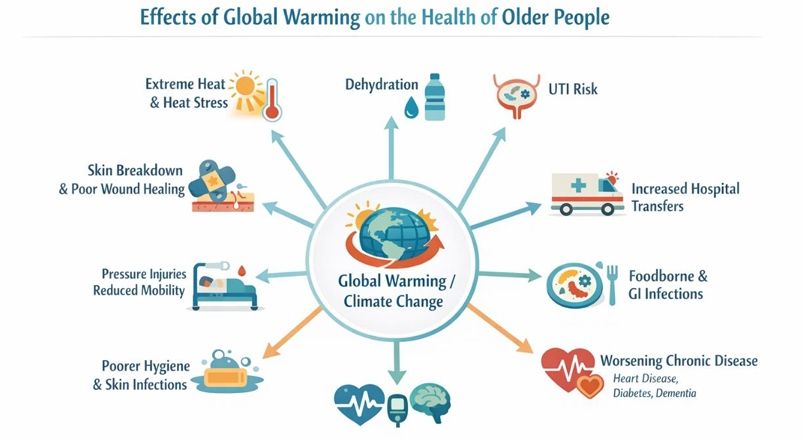
Heat affects the people in your care in ways that converge on infection risk:
dehydration, compromised skin integrity, and conditions that enable pathogens to
multiply and spread. Recognising these links enables your team to shift from reactive
outbreak management to proactive, season-ready prevention.
Global Warming

This article sets out what nurses, care workers, and governing bodies need to
understand about climate-driven infection risk, and the practical measures that protect
residents throughout every summer.
Why is climate change an infection prevention and control issue?
Older residents are among the most heat-vulnerable people in the community. Their
physiology offers a smaller buffer against extreme temperatures, and this vulnerability has
direct IPC consequences.
- Ageing skin produces less sweat, reducing the body’s ability to cool itself and regulate temperature.
- A reduced thirst response means residents often drink less, long before any problem is identified.
- Chronic conditions such as cardiovascular disease, diabetes, and dementia, together with several common medications, impair heat tolerance and fluid balance.
- Heat is the deadliest natural hazard in Australia, and a warming climate raises the
baseline risk that every facility must manage.
The Aged Care Quality and Safety Commission (ACQSC) now issues an annual summer
clinical alert on heat stress, while New Zealand is developing a national study of heat
vulnerability. Climate readiness is increasingly expected as part of clinical governance.
Sources: Summer Clinical Alert 2025–26 — Preventing Heat Stress in Older People (ACQSC, 2025); Impact of
Extreme Heat on Health in Australia — A Scoping Review (BMC Public Health, 2025)
How does heat increase dehydration and the risk of infection?
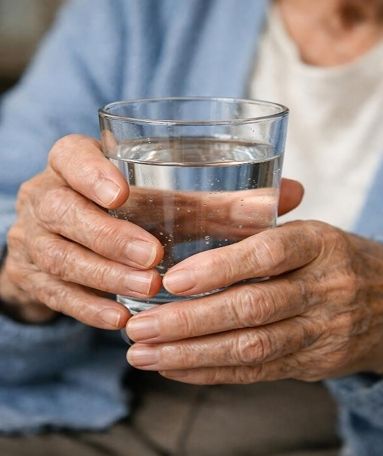
Dehydration is the most common and preventable heat-related problem in aged care, and it
rarely remains a simple fluid-balance issue.
- Older residents have less total body water, leaving a narrow margin before clinical dehydration is apparent.
- Swallowing difficulties, cognitive impairment, and reduced mobility all reduce fluid intake.
- Low fluid volume reduces urine output, weakening the flushing mechanism that removes bacteria from the urinary tract.
- This increases the risk of urinary tract infections (UTIs), a leading cause of hospital
transfers from aged care settings.
UTIs in older residents often present atypically, with acute confusion, agitation, or a fall
rather than classic UTI symptoms. Embedding hydration monitoring and structured fluid
rounds into daily care is one of the highest-yield IPC interventions available to your team.
Sources: Reducing Urinary Tract Infections in Care Homes by Improving Hydration (BMJ Open Quality, 2019);
Climate Change Impacts on Health in Aotearoa New Zealand — A Scoping Review (New Zealand Medical
Journal, 2025)
What does extreme heat mean for skin integrity and hygiene?
Skin is the body’s primary barrier to infection, and extreme heat places that barrier under
sustained stress.
- Ageing skin is thinner, drier, and slower to heal, making breaches both more likely and more serious.
- Perspiration and moisture trapped in skin folds promote maceration, irritation, and microbial colonisation.
- Skin tears and cracks in the skin allow direct entry for pathogens.
- Reduced mobility during heat events increases the risk of pressure injuries.
- Incontinence-associated dermatitis (IAD) is a significant and often under rrecognised
driver of skin breakdown in aged care. Heat and sweating increase moisture exposure
in the perineal and perigenital area, accelerating skin damage.
Hygiene practices carry greater weight in summer. Consistent skin assessment, emollient
use, prompt management of skin folds, and timely changes of damp linen and clothing all
reduce the risk of infection.
Source: Hygiene and Emollient Interventions for Maintaining Skin Integrity in Older People (Cochrane Review,
2019)
Can a warming climate increase infection rates in your facility?
Yes. Warmth favours many pathogens, and a communal residential setting offers them an
available opportunity to spread.
- Bacteria such as Salmonella and Campylobacter replicate more quickly in warm conditions, increasing the risk of foodborne illness.
- Australian research links heatwaves to a marked increase in Salmonella notifications.
- Power interruptions during extreme heat threaten the cold chain and food safety.
- In New Zealand, notifications of several gastrointestinal infections increase with
ambient temperature.
A single case of gastroenteritis can rapidly escalate into an outbreak in a shared living environment. A warming climate widens the window for transmission - which is precisely why surveillance and prevention must intensify, not relax, over summer.
Sources: Heatwaves Differentially Affect Risk of Salmonella Serotypes (Journal of Infection, 2016); Climate
Sensitive Diseases (Environmental Health Intelligence New Zealand, 2024)
What proactive IPC measures should be prioritised?
Most climate-driven infection risk is manageable through proactive, well-rehearsed practice.
The following measures should be embedded before summer, not improvised during a
heatwave.
- Structured hydration rounds: with fluid intake monitored and clear escalation pathways for residents who are under-hydrated.
- Verified cooling capacity: functioning air-conditioning, shaded areas, and routine temperature monitoring in communal and resident rooms.
- A documented summer heat plan: setting out roles, triggers, and heightened checks for the most vulnerable residents.
- Reinforced Standard Precautions: including hand hygiene, ready access to alcohol based hand rub (ABHR), and environmental cleaning.
- Food safety discipline: Power interruptions during extreme heat threaten the cold chain and food safety. Facilities should have a documented protocol that includes checking and logging refrigerator and freezer temperatures at least twice daily during heat events, discarding high-risk foods held above 5°C for more than two hours, and identifying a backup catering arrangement if cold storage is compromised for an extended period.
- Active surveillance: for early and often atypical signs of infection, supported by current resident vaccination.
- Heat and behavioural awareness: heat stress can present in residents as increased
agitation, confusion, or sleep disruption — states that complicate care delivery and
indirectly affect IPC compliance.
Sources: Aged Care IPC Guide (ACSQHC/ACQSC, 2024); Summer Clinical Alert 2025–26 — Preventing Heat
Stress in Older People (ACQSC, 2025)
Is Vector-borne disease a consideration for aged care providers?
Increasingly, yes. A warming climate is expanding the geographic range of mosquito
species that carry disease, and this is relevant to facilities in both Australia and New
Zealand.
- Ross River virus and Barmah Forest virus activity is increasing in range and season length across Australia, including in areas not previously considered high-risk.
- Dengue fever, historically confined to Far North Queensland, is a growing concern as mosquito ranges shift southward with rising temperatures.
- In New Zealand, Health New Zealand | Te Whatu Ora monitors for exotic mosquito
incursions, and climate projections suggest conditions suitable for mosquito-borne
transmission may emerge in northern regions over coming decades.
For aged care, the practical implication is environmental: ensure window and door
screening is intact, eliminate standing water on the property, and brief care staff to report
any unusual clusters of insect bites or unexplained febrile illness in residents, particularly
following warm wet periods.
Sources: Climate-Sensitive Diseases (Environmental Health Intelligence New Zealand, 2024); Ross River Virus
Disease — Australian Government Department of Health and Aged Care (2024)
What is the role of clinical governance?
Climate-related infection risk is a responsibility of the Governing Body as well as a frontline
responsibility. Heat readiness should be embedded within the facility’s clinical governance
framework.
- The Governing Body should ensure that a current, resourced heat and IPC plan is in place.
- The IPC Lead should integrate seasonal climate risk into the facility risk register, the surveillance program, and the education calendar.
- Heat-season events, including heat stress, dehydration, and infection clusters, should be reviewed for systemic learning rather than addressed in isolation.
- Documentation of these measures provides evidence of compliance with the
Strengthened Aged Care Quality Standards and, in New Zealand, with NZS 8134:2021.
A warming climate is now a permanent feature of the aged care operating environment.
Providers that treat heat readiness as a core IPC priority, owned at the governance level
and enacted by every member of the care team, will protect their residents far more
effectively than those who respond only reactively when temperatures climb.
Sources: Strengthened Aged Care Quality Standards — Standard 5 Safe and Effective Care (effective 1
November 2025); NZS 8134:2021 Ngā Paerewa Health and Disability Services Standard
Read more of our blogs on the IPS website, the HUB. We would love to hear your
suggestions on topics.
A quick question, use EVE – who can answer your question in several languages.
If you wish to contact one of our friendly staff, please email support@infectioncontrol.care
Follow us on Facebook or LinkedIn.
A quick question, use EVE – who can answer your question in several languages.
If you wish to contact one of our friendly staff, please email support@infectioncontrol.care
Follow us on Facebook or LinkedIn.
Lyndon Forrest
Managing Director | CEO
Lyndon is the Managing Director of Infection Prevention Services (IPS), bringing over 30 years' experience supporting aged care providers across Australia and New Zealand.
With a background spanning outbreak response, compliance, and infection risk management — alongside hands-on experience leading teams, managing multi-site operations, and navigating business turnaround — he understands both the clinical and organisational pressures aged care providers face. Lyndon holds a Master of Commerce (Industrial Relations), and applies that foundation to the people, process, and growth challenges that come with running a complex healthcare services business.
He is passionate about building the systems and capability that make infection prevention sustainable — not just compliant — and about helping organisations grow their confidence alongside their practice.
Lyndon's focus is straightforward: strengthen operations, develop the right people, and drive proactive infection prevention strategies that protect residents, staff, and communities for the long term.
Lyndon is the Managing Director of Infection Prevention Services (IPS), bringing over 30 years' experience supporting aged care providers across Australia and New Zealand.
With a background spanning outbreak response, compliance, and infection risk management — alongside hands-on experience leading teams, managing multi-site operations, and navigating business turnaround — he understands both the clinical and organisational pressures aged care providers face. Lyndon holds a Master of Commerce (Industrial Relations), and applies that foundation to the people, process, and growth challenges that come with running a complex healthcare services business.
He is passionate about building the systems and capability that make infection prevention sustainable — not just compliant — and about helping organisations grow their confidence alongside their practice.
Lyndon's focus is straightforward: strengthen operations, develop the right people, and drive proactive infection prevention strategies that protect residents, staff, and communities for the long term.
Erica Callaghan
Marketing Manager
Erica Callaghan is a dedicated professional with a rich background in agriculture and nutrient management. Growing up on her family's farm in Mid Canterbury, she developed a deep passion for farming. She currently resides on her partner's arable property in South Canterbury.
In 2017, Erica joined the Farm Sustainability team, focusing on nutrient management and environmental stewardship. In February 2024, she became the Manager of Marketing and Sales at Bug Control New Zealand - Infection Prevention Services, where her passion now includes improving infection prevention outcomes.
Outside of work, Erica loves cooking and traveling, often combining her culinary interests with her explorations in Italy and Vietnam. She enjoys entertaining family and friends and remains actively involved in farm activities, especially during harvest season.
Erica Callaghan is a dedicated professional with a rich background in agriculture and nutrient management. Growing up on her family's farm in Mid Canterbury, she developed a deep passion for farming. She currently resides on her partner's arable property in South Canterbury.
In 2017, Erica joined the Farm Sustainability team, focusing on nutrient management and environmental stewardship. In February 2024, she became the Manager of Marketing and Sales at Bug Control New Zealand - Infection Prevention Services, where her passion now includes improving infection prevention outcomes.
Outside of work, Erica loves cooking and traveling, often combining her culinary interests with her explorations in Italy and Vietnam. She enjoys entertaining family and friends and remains actively involved in farm activities, especially during harvest season.
Toni Sherriff
Clinical Nurse Specialist
Toni is a Registered Nurse with extensive experience in Infection Prevention and Control. Her career began as a kitchen hand and caregiver in Aged Care facilities, followed by earning a Bachelor of Nursing.
Toni has significant experience, having worked in Brisbane’s Infectious Diseases ward before returning home to New Zealand, where she continued her career as a Clinical Nurse Specialist in Infection Prevention and Control within Te Whatu Ora (Health NZ).
Toni brings her expertise and dedication to our team, which is instrumental in providing top-tier infection prevention solutions to our clients.
Toni is a Registered Nurse with extensive experience in Infection Prevention and Control. Her career began as a kitchen hand and caregiver in Aged Care facilities, followed by earning a Bachelor of Nursing.
Toni has significant experience, having worked in Brisbane’s Infectious Diseases ward before returning home to New Zealand, where she continued her career as a Clinical Nurse Specialist in Infection Prevention and Control within Te Whatu Ora (Health NZ).
Toni brings her expertise and dedication to our team, which is instrumental in providing top-tier infection prevention solutions to our clients.
Julie Hadfield
Accounts & Payroll
Julie is experienced in Accounts & Payroll Administration & after a long career in both the Financial & Local Government Sectors, is now working with our team. Julie brings her strong time management & organisational skills to our team, which is important to keep the company running in the background to enable the rest of our team to provide top notch service to all of our clients.
Julie is experienced in Accounts & Payroll Administration & after a long career in both the Financial & Local Government Sectors, is now working with our team. Julie brings her strong time management & organisational skills to our team, which is important to keep the company running in the background to enable the rest of our team to provide top notch service to all of our clients.
Andrea Murray
Content Editor
I attended Otago University in NZ and graduated as a Dental Surgeon. After 40 years in the profession, I retired in 2022. Infection prevention knowledge was part of everyday practice, dealing with sterilisation, hand hygiene, and cleaning.
Before retiring, I began doing some editing and proofreading for Bug Control as I am interested in the subject and in the English language. During the COVID-19 lockdown, I attended the ACIPC course "Introduction to Infection Prevention and Control", which increased my interest in the subject. I now work part-time as the Content Editor for the company.
I attended Otago University in NZ and graduated as a Dental Surgeon. After 40 years in the profession, I retired in 2022. Infection prevention knowledge was part of everyday practice, dealing with sterilisation, hand hygiene, and cleaning.
Before retiring, I began doing some editing and proofreading for Bug Control as I am interested in the subject and in the English language. During the COVID-19 lockdown, I attended the ACIPC course "Introduction to Infection Prevention and Control", which increased my interest in the subject. I now work part-time as the Content Editor for the company.
Personally, I lived in the UK for 10 years. My two children were born in Scotland, and now both are living in Europe, one in Amsterdam, Netherlands, and the other in Edinburgh, Scotland. I live close to Fairlie on the South Island of NZ, a beautiful part of the country, and I love being out of the city.
Princess
Customer Support
Princess began her career as a dedicated Customer Service Representative, honing her communication and problem-solving skills. She later transitioned into a Literary Specialist role, where she developed a keen eye for detail. Her journey then led her to a Sales Specialist position, where she excelled in client relations.
Now, as a Customer Support professional in Infection Prevention Services. Princess focuses on ensuring customer satisfaction, building loyalty, and enhancing the overall customer journey.
Princess began her career as a dedicated Customer Service Representative, honing her communication and problem-solving skills. She later transitioned into a Literary Specialist role, where she developed a keen eye for detail. Her journey then led her to a Sales Specialist position, where she excelled in client relations.
Now, as a Customer Support professional in Infection Prevention Services. Princess focuses on ensuring customer satisfaction, building loyalty, and enhancing the overall customer journey.
Dianne Newey
Senior Infection Prevention and Control Consultant
Dianne is a Senior Clinical Consultant at Infection Prevention Services (IPS), bringing over 35 years of nursing experience and a depth of clinical knowledge that most people would need two careers to accumulate.
Having served as Clinical Director at Royal Ryde Rehabilitation Hospital alongside a career spanning the full breadth of clinical practice, Dianne has seen it all — and more importantly, knows exactly what to do about it. She is the person in the room that everyone quietly hopes will speak first.
For more than seven years she has been a cornerstone of the IPS team, providing clinical advice, developing and reviewing policies and procedures, delivering monthly IPC webinars to IP Leads, and conducting environmental audits in aged care facilities across Australia and New Zealand. If infection prevention has a question, Dianne almost certainly has the answer — and she'll deliver it with a laugh that you'll hear from the other end of the corridor.
A true fountain of knowledge, wrapped in the kind of warmth and humour that only three decades of nursing can produce. Customers don't just trust Dianne — they look forward to hearing from her.
Dianne is a Senior Clinical Consultant at Infection Prevention Services (IPS), bringing over 35 years of nursing experience and a depth of clinical knowledge that most people would need two careers to accumulate.
Having served as Clinical Director at Royal Ryde Rehabilitation Hospital alongside a career spanning the full breadth of clinical practice, Dianne has seen it all — and more importantly, knows exactly what to do about it. She is the person in the room that everyone quietly hopes will speak first.
For more than seven years she has been a cornerstone of the IPS team, providing clinical advice, developing and reviewing policies and procedures, delivering monthly IPC webinars to IP Leads, and conducting environmental audits in aged care facilities across Australia and New Zealand. If infection prevention has a question, Dianne almost certainly has the answer — and she'll deliver it with a laugh that you'll hear from the other end of the corridor.
A true fountain of knowledge, wrapped in the kind of warmth and humour that only three decades of nursing can produce. Customers don't just trust Dianne — they look forward to hearing from her.
Caoimhe (Keva) Stewart
Clinical & Business Operations Manager
Caoimhe is the Clinical & Business Operations Manager at Infection Prevention Services (IPS), bringing a clinical background as a Registered Nurse across the UK and Australia — and an almost unsettling ability to make technology do exactly what she wants.
With experience in Occupational Health, Palliative Care, and Community Nursing, she understands the real challenges faced by healthcare teams. What she may lack in stature she more than makes up for in impact — Caoimhe is the kind of person who walks into a problem, sizes it up, and has three solutions before anyone else has finished reading the brief.
Customers love her. Not just because she delivers — though she always does — but because she genuinely cares about the outcome on the other side. She is passionate about creating seamless learning experiences and empowering organisations with the tools, knowledge, and support needed to strengthen infection prevention practices and improve care outcomes.
Small in size. Mighty in results. Completely irreplaceable.
Caoimhe is the Clinical & Business Operations Manager at Infection Prevention Services (IPS), bringing a clinical background as a Registered Nurse across the UK and Australia — and an almost unsettling ability to make technology do exactly what she wants.
With experience in Occupational Health, Palliative Care, and Community Nursing, she understands the real challenges faced by healthcare teams. What she may lack in stature she more than makes up for in impact — Caoimhe is the kind of person who walks into a problem, sizes it up, and has three solutions before anyone else has finished reading the brief.
Customers love her. Not just because she delivers — though she always does — but because she genuinely cares about the outcome on the other side. She is passionate about creating seamless learning experiences and empowering organisations with the tools, knowledge, and support needed to strengthen infection prevention practices and improve care outcomes.
Small in size. Mighty in results. Completely irreplaceable.
Bridgette Mackie
Clinical Nurse Educator
Bridgette is an experienced New Zealand Registered Nurse, qualified Healthcare Auditor, and Healthcare Educator with a strong background in clinical quality, competency assessment, and infection prevention. She has led large-scale OSCE and CAP training programmes for internationally qualified nurses, developed sector-specific educational resources, and coordinated HealthCERT audit preparation in the surgical sector.
Known for her engaging teaching style and genuine passion for supporting learners, Bridgette excels at making complex topics accessible and relevant. She blends operational leadership with a deep commitment to professional development and safe, effective practice.
Bridgette is an experienced New Zealand Registered Nurse, qualified Healthcare Auditor, and Healthcare Educator with a strong background in clinical quality, competency assessment, and infection prevention. She has led large-scale OSCE and CAP training programmes for internationally qualified nurses, developed sector-specific educational resources, and coordinated HealthCERT audit preparation in the surgical sector.
Known for her engaging teaching style and genuine passion for supporting learners, Bridgette excels at making complex topics accessible and relevant. She blends operational leadership with a deep commitment to professional development and safe, effective practice.