
Jun 20
Healthcare-Associated Infections in Aged Care: Types, Risk Factors & Seasonal Patterns for Australian and New Zealand Facilities
Types, Risk Factors & Seasonal Patterns for Australian and New Zealand Facilities
Healthcare-associated infections in aged care include UTIs, respiratory infections,
skin infections, and gastro. Learn risk factors, atypical presentations, and seasonal
trends for Australian and New Zealand IPC leads and care teams.
Healthcare-associated infections (HAIs) are among the most persistent threats in
residential aged care, and one of the most preventable. They affect residents at
every level of care, drive unnecessary hospitalisations, and place real pressure on
your team every day. Yet too often, they're treated as an inevitable part of the
landscape rather than what they are: a signal that something in our care systems
can be improved.
This is the first of two blogs on HAIs in aged care. Here, we look at what they are, the
infections you're most likely to encounter, why your residents are particularly
vulnerable, and how the seasons may affect risk. The second blog covers outcomes,
treatment, and how surveillance can sharpen your facility's response.
What Is a Healthcare-Associated Infection?
A healthcare-associated infection is any infection acquired as a result of, or in
connection with, receiving healthcare or residing in a care setting. In aged care, that
definition is broad. It includes infections that develop in residents more than 48
hours after admission; infections linked to invasive devices such as urinary
catheters; infections arising from clinical procedures; and outbreaks of
gastroenteritis or respiratory illness that spread within your facility.
HAIs in aged care are not rare. European point-prevalence data show that over 12
months, more than half of residents in long-term care facilities experience at least
one HAI. Even in point-in-time surveys, HAI prevalence consistently remains at 2–5%
on any given day. That's a significant clinical burden, and it's largely on your team
to detect it early.
Why Are Aged Care Residents So Vulnerable?
Understanding the "why" matters because it shapes everything from your IPC
program design to how you interpret a resident's clinical picture.
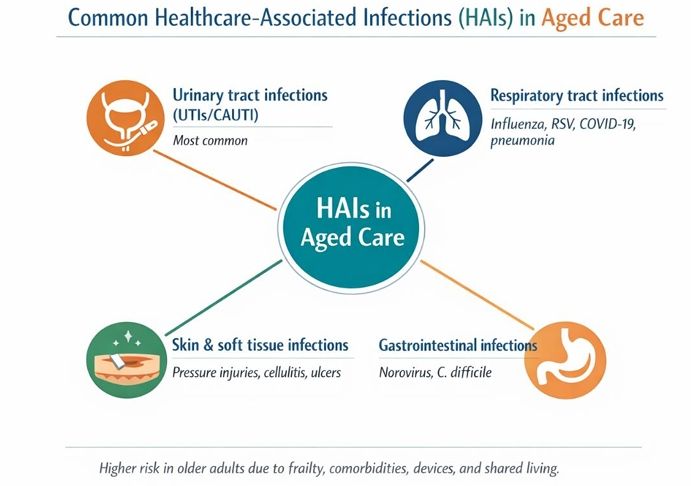
Older residents face a combination of risk factors that compound one another:
- Immunosenescence: age-related decline in immune function means a slower, weaker response to pathogens
- Comorbidities: diabetes, chronic lung disease, heart failure, and dementia all increase susceptibility to infection
- Reduced physiological reserve: less capacity to mount a fever or to produce classic infection symptoms
- Invasive devices: urinary catheters, percutaneous endoscopic gastrostomy (PEG) tubes, and subcutanenous access all provide entry points for pathogens
- Congregate living: shared spaces, shared staff, and high contact ratios increase transmission risk
- Cognitive impairment: residents may be unable to report symptoms, and
behavioural changes can be the only early signal
This is also why presentations are so often atypical. A resident with pneumonia may not have a cough or fever; they may be more confused, eating less, or falling. Recognising infection in this context requires clinical skill, vigilance, and a well coordinated team.
The Four HAIs You'll Encounter Most
1. Urinary Tract Infections
Urinary tract infections (UTIs) are the most frequently diagnosed HAI in aged care;
some studies have found that up to 46% of all HAIs are UTIs. They're also the most
over diagnosed. Asymptomatic bacteriuria, defined as bacteria in the urine without
any signs of infection, is extremely common in older residents, particularly women,
and does not require treatment. Yet the reflex urinalysis dipstick has driven decades
of inappropriate antibiotic prescribing.
The strongest independent risk factor for a genuine UTI is an indwelling urinary
catheter. Residents with a Foley catheter face a 3–7% daily risk of acquiring a
catheter-associated UTI (CAUTI). Each day the catheter remains in place increases
the risk, which is why the necessity of a catheter must be actively reviewed rather
than passively accepted.
Accurate diagnosis is critical to antimicrobial stewardship, reducing unnecessary
antibiotic use and the risk of resistance and Clostridioides difficile infection.
2. Respiratory Tract Infections
Respiratory tract infections (RTIs) are the second most common HAI in aged care
and the most deadly. Pneumonia is the leading cause of death among aged care
residents. RTIs include influenza, respiratory syncytial virus (RSV), human
metapneumovirus (HMPV), COVID-19, and pneumococcal pneumonia. Aspiration
pneumonia is a distinct and significant subtype, driven by swallowing dysfunction,
poor oral hygiene, and an impaired cough reflex.
Vaccination programmes (influenza, COVID-19, and pneumococcal where
indicated) remain a cornerstone of prevention in aged care.
3. Skin and Soft Tissue Infections
Often underestimated, skin and soft tissue infections collectively account for up to
32% of HAIs in some facility surveys. This category includes infected pressure
injuries, cellulitis, fungal skin infections, and infected leg ulcers. Because they
develop gradually and may not trigger obvious systemic signs early, they can be
missed during routine assessment or dismissed as "the wound is just a bit worse
today".
4. Gastrointestinal Infections
Norovirus and Clostridioides difficile (C. diff) each warrant separate discussion.
Norovirus spreads rapidly in congregate settings and can overwhelm your facility's
cohorting capacity within 24 hours. C. diff is particularly concerning because its
primary driver is antibiotic use, a reminder that every antibiotic decision has
downstream consequences. The McGeer criteria, revised in 2012, now include
specific surveillance definitions for norovirus gastroenteritis and C. diff.

Does the Season Change the Risks? Absolutely.
Infection risk in aged care is year-round, but its character shifts with the seasons,
and anticipating that shift is the difference between a proactive facility and a
reactive one.
Winter: (June–September in Australasia) is the highest-risk period for respiratory
infections. Influenza, RSV, HMPV, and rhinovirus all peak sharply as people spend
more time indoors, ventilation drops, and residents are in closer proximity.
Australian flu season data from 2016–2022 confirm consistently elevated RTI rates
across residential aged care facilities during these months. Norovirus outbreaks
also cluster in winter.
Summer: brings a different risk profile, one that's less recognised but equally real.
Research on nursing home bacterial pathogens shows summer peaks in Klebsiella
pneumoniae and ciprofloxacin-resistant Escherichia coli, two of the most common
UTI pathogens. The likely driver? Dehydration. Reduced fluid intake concentrates
urine, reduces natural bladder flushing, and increases the risk of catheter-related
complications. Your hydration practices in summer aren't just comfort measures;
they're infection prevention.
Spring: shows peaks in vancomycin-resistant enterococci (VRE) and methicillin resistant Staphylococcus aureus (MRSA), though the mechanisms are less well understood.
The practical takeaway: your infection prevention planning should be seasonal.
- Winter means respiratory readiness - vaccination drives, outbreak protocols, and PPE stocks
- Summer means UTI vigilance - hydration rounds, catheter reviews, and surveillance.
What This Means for Your Facility
HAIs in aged care are not random misfortune. They follow patterns - by infection
type, by resident risk factor, and by season - which means they're foreseeable. Your
team, from care workers to the Facility Manager, is best placed to spot early signals:
the resident who's "just a bit off", the catheter that's been in place longer than
anyone remembers, and the first two cases of vomiting on a Tuesday afternoon.

The second blog in this series looks at what happens when HAIs aren't detected
early - the outcomes, the treatment in this context, and how surveillance tools like
the McGeer criteria help you build a picture of infection activity across your facility
over time.
*Sources: Stone et al., 'Surveillance definitions of infections in long-term care
facilities: revisiting the McGeer criteria' (Infection Control and Hospital
Epidemiology, 2012); Incidence of HAI in long-term care facilities in nine European
countries (PMC, 2025); Seasonal Patterns in Incidence and Antimicrobial Resistance
of Common Bacterial Pathogens in Nursing Home Patients (PMC, 2021); Aged Care
Infection Prevention and Control Guide (ACSQHC); Preventing and Controlling
Infections in Delivering Clinical Care Services, Outcome 5.2 (Aged Care Quality and
Safety Commission, 2025).*
More blogs are available on the HUB, along with current information for your facility.
We are on Facebook and LinkedIn – like us, share and follow
To contact us – support@infectioncontrol.care
Be sure to read the second blog in this series.
To contact us – support@infectioncontrol.care
Be sure to read the second blog in this series.
Lyndon Forrest
Managing Director | CEO
Lyndon is the Managing Director of Infection Prevention Services (IPS), bringing over 30 years' experience supporting aged care providers across Australia and New Zealand.
With a background spanning outbreak response, compliance, and infection risk management — alongside hands-on experience leading teams, managing multi-site operations, and navigating business turnaround — he understands both the clinical and organisational pressures aged care providers face. Lyndon holds a Master of Commerce (Industrial Relations), and applies that foundation to the people, process, and growth challenges that come with running a complex healthcare services business.
He is passionate about building the systems and capability that make infection prevention sustainable — not just compliant — and about helping organisations grow their confidence alongside their practice.
Lyndon's focus is straightforward: strengthen operations, develop the right people, and drive proactive infection prevention strategies that protect residents, staff, and communities for the long term.
Lyndon is the Managing Director of Infection Prevention Services (IPS), bringing over 30 years' experience supporting aged care providers across Australia and New Zealand.
With a background spanning outbreak response, compliance, and infection risk management — alongside hands-on experience leading teams, managing multi-site operations, and navigating business turnaround — he understands both the clinical and organisational pressures aged care providers face. Lyndon holds a Master of Commerce (Industrial Relations), and applies that foundation to the people, process, and growth challenges that come with running a complex healthcare services business.
He is passionate about building the systems and capability that make infection prevention sustainable — not just compliant — and about helping organisations grow their confidence alongside their practice.
Lyndon's focus is straightforward: strengthen operations, develop the right people, and drive proactive infection prevention strategies that protect residents, staff, and communities for the long term.
Erica Callaghan
Marketing Manager
Erica Callaghan is a dedicated professional with a rich background in agriculture and nutrient management. Growing up on her family's farm in Mid Canterbury, she developed a deep passion for farming. She currently resides on her partner's arable property in South Canterbury.
In 2017, Erica joined the Farm Sustainability team, focusing on nutrient management and environmental stewardship. In February 2024, she became the Manager of Marketing and Sales at Bug Control New Zealand - Infection Prevention Services, where her passion now includes improving infection prevention outcomes.
Outside of work, Erica loves cooking and traveling, often combining her culinary interests with her explorations in Italy and Vietnam. She enjoys entertaining family and friends and remains actively involved in farm activities, especially during harvest season.
Erica Callaghan is a dedicated professional with a rich background in agriculture and nutrient management. Growing up on her family's farm in Mid Canterbury, she developed a deep passion for farming. She currently resides on her partner's arable property in South Canterbury.
In 2017, Erica joined the Farm Sustainability team, focusing on nutrient management and environmental stewardship. In February 2024, she became the Manager of Marketing and Sales at Bug Control New Zealand - Infection Prevention Services, where her passion now includes improving infection prevention outcomes.
Outside of work, Erica loves cooking and traveling, often combining her culinary interests with her explorations in Italy and Vietnam. She enjoys entertaining family and friends and remains actively involved in farm activities, especially during harvest season.
Toni Sherriff
Clinical Nurse Specialist
Toni is a Registered Nurse with extensive experience in Infection Prevention and Control. Her career began as a kitchen hand and caregiver in Aged Care facilities, followed by earning a Bachelor of Nursing.
Toni has significant experience, having worked in Brisbane’s Infectious Diseases ward before returning home to New Zealand, where she continued her career as a Clinical Nurse Specialist in Infection Prevention and Control within Te Whatu Ora (Health NZ).
Toni brings her expertise and dedication to our team, which is instrumental in providing top-tier infection prevention solutions to our clients.
Toni is a Registered Nurse with extensive experience in Infection Prevention and Control. Her career began as a kitchen hand and caregiver in Aged Care facilities, followed by earning a Bachelor of Nursing.
Toni has significant experience, having worked in Brisbane’s Infectious Diseases ward before returning home to New Zealand, where she continued her career as a Clinical Nurse Specialist in Infection Prevention and Control within Te Whatu Ora (Health NZ).
Toni brings her expertise and dedication to our team, which is instrumental in providing top-tier infection prevention solutions to our clients.
Julie Hadfield
Accounts & Payroll
Julie is experienced in Accounts & Payroll Administration & after a long career in both the Financial & Local Government Sectors, is now working with our team. Julie brings her strong time management & organisational skills to our team, which is important to keep the company running in the background to enable the rest of our team to provide top notch service to all of our clients.
Julie is experienced in Accounts & Payroll Administration & after a long career in both the Financial & Local Government Sectors, is now working with our team. Julie brings her strong time management & organisational skills to our team, which is important to keep the company running in the background to enable the rest of our team to provide top notch service to all of our clients.
Andrea Murray
Content Editor
I attended Otago University in NZ and graduated as a Dental Surgeon. After 40 years in the profession, I retired in 2022. Infection prevention knowledge was part of everyday practice, dealing with sterilisation, hand hygiene, and cleaning.
Before retiring, I began doing some editing and proofreading for Bug Control as I am interested in the subject and in the English language. During the COVID-19 lockdown, I attended the ACIPC course "Introduction to Infection Prevention and Control", which increased my interest in the subject. I now work part-time as the Content Editor for the company.
I attended Otago University in NZ and graduated as a Dental Surgeon. After 40 years in the profession, I retired in 2022. Infection prevention knowledge was part of everyday practice, dealing with sterilisation, hand hygiene, and cleaning.
Before retiring, I began doing some editing and proofreading for Bug Control as I am interested in the subject and in the English language. During the COVID-19 lockdown, I attended the ACIPC course "Introduction to Infection Prevention and Control", which increased my interest in the subject. I now work part-time as the Content Editor for the company.
Personally, I lived in the UK for 10 years. My two children were born in Scotland, and now both are living in Europe, one in Amsterdam, Netherlands, and the other in Edinburgh, Scotland. I live close to Fairlie on the South Island of NZ, a beautiful part of the country, and I love being out of the city.
Princess
Customer Support
Princess began her career as a dedicated Customer Service Representative, honing her communication and problem-solving skills. She later transitioned into a Literary Specialist role, where she developed a keen eye for detail. Her journey then led her to a Sales Specialist position, where she excelled in client relations.
Now, as a Customer Support professional in Infection Prevention Services. Princess focuses on ensuring customer satisfaction, building loyalty, and enhancing the overall customer journey.
Princess began her career as a dedicated Customer Service Representative, honing her communication and problem-solving skills. She later transitioned into a Literary Specialist role, where she developed a keen eye for detail. Her journey then led her to a Sales Specialist position, where she excelled in client relations.
Now, as a Customer Support professional in Infection Prevention Services. Princess focuses on ensuring customer satisfaction, building loyalty, and enhancing the overall customer journey.
Dianne Newey
Senior Infection Prevention and Control Consultant
Dianne is a Senior Clinical Consultant at Infection Prevention Services (IPS), bringing over 35 years of nursing experience and a depth of clinical knowledge that most people would need two careers to accumulate.
Having served as Clinical Director at Royal Ryde Rehabilitation Hospital alongside a career spanning the full breadth of clinical practice, Dianne has seen it all — and more importantly, knows exactly what to do about it. She is the person in the room that everyone quietly hopes will speak first.
For more than seven years she has been a cornerstone of the IPS team, providing clinical advice, developing and reviewing policies and procedures, delivering monthly IPC webinars to IP Leads, and conducting environmental audits in aged care facilities across Australia and New Zealand. If infection prevention has a question, Dianne almost certainly has the answer — and she'll deliver it with a laugh that you'll hear from the other end of the corridor.
A true fountain of knowledge, wrapped in the kind of warmth and humour that only three decades of nursing can produce. Customers don't just trust Dianne — they look forward to hearing from her.
Dianne is a Senior Clinical Consultant at Infection Prevention Services (IPS), bringing over 35 years of nursing experience and a depth of clinical knowledge that most people would need two careers to accumulate.
Having served as Clinical Director at Royal Ryde Rehabilitation Hospital alongside a career spanning the full breadth of clinical practice, Dianne has seen it all — and more importantly, knows exactly what to do about it. She is the person in the room that everyone quietly hopes will speak first.
For more than seven years she has been a cornerstone of the IPS team, providing clinical advice, developing and reviewing policies and procedures, delivering monthly IPC webinars to IP Leads, and conducting environmental audits in aged care facilities across Australia and New Zealand. If infection prevention has a question, Dianne almost certainly has the answer — and she'll deliver it with a laugh that you'll hear from the other end of the corridor.
A true fountain of knowledge, wrapped in the kind of warmth and humour that only three decades of nursing can produce. Customers don't just trust Dianne — they look forward to hearing from her.
Caoimhe (Keva) Stewart
Clinical & Business Operations Manager
Caoimhe is the Clinical & Business Operations Manager at Infection Prevention Services (IPS), bringing a clinical background as a Registered Nurse across the UK and Australia — and an almost unsettling ability to make technology do exactly what she wants.
With experience in Occupational Health, Palliative Care, and Community Nursing, she understands the real challenges faced by healthcare teams. What she may lack in stature she more than makes up for in impact — Caoimhe is the kind of person who walks into a problem, sizes it up, and has three solutions before anyone else has finished reading the brief.
Customers love her. Not just because she delivers — though she always does — but because she genuinely cares about the outcome on the other side. She is passionate about creating seamless learning experiences and empowering organisations with the tools, knowledge, and support needed to strengthen infection prevention practices and improve care outcomes.
Small in size. Mighty in results. Completely irreplaceable.
Caoimhe is the Clinical & Business Operations Manager at Infection Prevention Services (IPS), bringing a clinical background as a Registered Nurse across the UK and Australia — and an almost unsettling ability to make technology do exactly what she wants.
With experience in Occupational Health, Palliative Care, and Community Nursing, she understands the real challenges faced by healthcare teams. What she may lack in stature she more than makes up for in impact — Caoimhe is the kind of person who walks into a problem, sizes it up, and has three solutions before anyone else has finished reading the brief.
Customers love her. Not just because she delivers — though she always does — but because she genuinely cares about the outcome on the other side. She is passionate about creating seamless learning experiences and empowering organisations with the tools, knowledge, and support needed to strengthen infection prevention practices and improve care outcomes.
Small in size. Mighty in results. Completely irreplaceable.
Bridgette Mackie
Clinical Nurse Educator
Bridgette is an experienced New Zealand Registered Nurse, qualified Healthcare Auditor, and Healthcare Educator with a strong background in clinical quality, competency assessment, and infection prevention. She has led large-scale OSCE and CAP training programmes for internationally qualified nurses, developed sector-specific educational resources, and coordinated HealthCERT audit preparation in the surgical sector.
Known for her engaging teaching style and genuine passion for supporting learners, Bridgette excels at making complex topics accessible and relevant. She blends operational leadership with a deep commitment to professional development and safe, effective practice.
Bridgette is an experienced New Zealand Registered Nurse, qualified Healthcare Auditor, and Healthcare Educator with a strong background in clinical quality, competency assessment, and infection prevention. She has led large-scale OSCE and CAP training programmes for internationally qualified nurses, developed sector-specific educational resources, and coordinated HealthCERT audit preparation in the surgical sector.
Known for her engaging teaching style and genuine passion for supporting learners, Bridgette excels at making complex topics accessible and relevant. She blends operational leadership with a deep commitment to professional development and safe, effective practice.