
Jul 9
IPC Training Requirements for Aged Care Workers Under the Strengthened Standards
A competency-first approach to induction, refreshers, and infection prevention training for RACF teams in Australia and New Zealand.
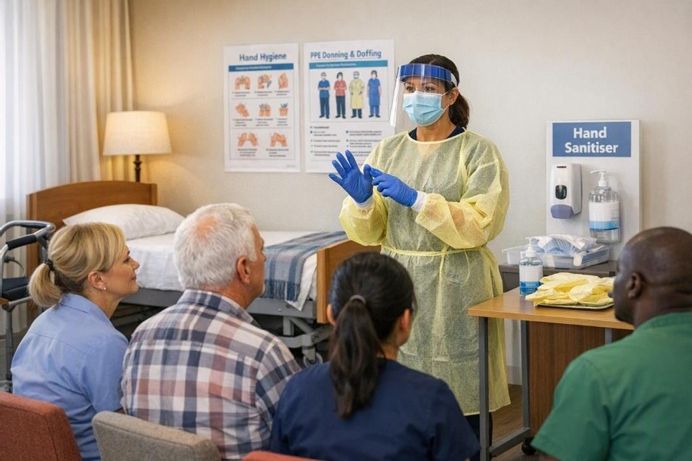
Residential aged care providers must ensure all workers receive infection prevention and control education appropriate to their role, with evidence that competency—not simply attendance—can be demonstrated. Under the Strengthened Aged Care Quality Standards (effective 1 November 2025), training for every staff group in a residential aged care facility (RACF), including contractors, covers hand hygiene, precautions, personal protective equipment (PPE), and outbreak response. This blog sets out what to cover, how often to refresh training, how to demonstrate competency rather than mere attendance, and how to reach the diverse workforces that keep Australian and New Zealand aged care running.
Key takeaways
- IPC education must be repeated when practices change, after significant incidents, or following major audit findings - not just at the standard annual interval. Source: Aged Care Infection Prevention and Control Guide, v1.1 (Australian Commission on Safety and Quality in Health Care [ACSQHC], 2025).
- Numerous implementation studies and infection prevention reviews have shown that education combined with observation, feedback and coaching is more effective than education alone.
- Train-the-trainer models enable facilities to scale IPC education when the IPC Lead cannot reach every shift in person.
- Documentation is the evidence base for accreditation - a completed module proves attendance, not competence. Assessors will expect evidence that staff have completed education and can demonstrate competency in practice through observation, assessment, supervision or other documented evidence.
- IPC and antimicrobial stewardship (AMS) education should be planned together; prescribers, pharmacists, nursing staff, and residents or carers all need role-specific AMS content, ideally coordinated by the IPC Lead with the facility's medical advisor and pharmacist.
- Every new worker—including agency staff, students, volunteers and contractors—should
receive IPC orientation before commencing resident-facing duties. Orientation should
include local policies, outbreak reporting pathways, PPE locations, hand hygiene
facilities, and emergency contacts.
What IPC topics must RACF training cover?
A defensible IPC training program covers Standard Precautions, transmission-based
precautions, hand hygiene, PPE - selection and donning/doffing competency, respiratory
etiquette, waste handling, and outbreak roles. It should also include the basics of environmental
cleaning, safe handling of linen and equipment, and the facility's process for reporting IPC
concerns.
Depth should be tailored by role rather than delivered as one generic module for the whole workforce:
Depth should be tailored by role rather than delivered as one generic module for the whole workforce:
- Clinical staff need standard precautions, full transmission-based precautions, vaccine preventable disease education, aseptic technique, safe infection practices and outbreak coordination content, plus training in inserting, managing, and removing invasive devices - including indwelling and suprapubic catheters, PEG tubes, and subcutaneous infusion devices such as CADD pumps and syringe drivers.
- Care staff need practical training in hand hygiene, PPE – selection, donning and doffing, and recognition of early signs of infection.
- Hospitality staff (kitchen, laundry, cleaning) need training in food safety crossover points, linen handling, waste segregation, biological and chemical spill management, safe use and storage of cleaning chemicals, cleaning equipment decontamination and manual handling for heavy lifting tasks.
- Maintenance and contractor staff need entry protocols, foundational IPC training relevant
to their work tasks that is non-clinical, practical instruction on standard precautions,
specifically hand hygiene, appropriate PPE requirements for their tasks, safe waste
disposal relevant to their work tasks, water safety and Legionella awareness and
guidance on whom to notify before entering an outbreak zone.
Every version should also explain how to raise IPC concerns without fear of blame - a just culture, where near misses are reported rather than hidden, turns training into a safety system rather than a compliance exercise.
Sharps safety and invasive device training have their own triggers beyond the standard cycle: repeat them whenever a new device or safety-engineered sharp is introduced, and immediately after a needlestick injury or an unexplained cluster of infections. A Clinical Educator typically delivers this content, working alongside the IPC team rather than replacing the IPC team.
How often should IPC training be refreshed?
At a minimum: at induction, annually thereafter, and immediately after an outbreak or a
significant audit finding. Annual education is the minimum expectation. Facilities should increase
frequency where audits, outbreaks, incidents or workforce turnover indicate additional support is
required.
High-turnover workforces - common across residential aged care in both Australia and New Zealand - often need more frequent, shorter training sessions rather than a single long annual session. Quarterly micro-sessions on a single skill (hand hygiene technique one quarter, PPE donning and doffing the next), paired with indirect observation and competency testing, keep knowledge current without pulling staff off the floor for hours at a time. This approach also suits agency and casual staff, who may be rostered for only a handful of shifts between formal refreshers.
Training should also be repeated whenever practice changes - a new PPE supplier, an updated outbreak protocol, or a change to precaution signage all warrant a short, targeted refresher rather than waiting for the next scheduled session. Waste segregation and handling training should be refreshed on the same trigger basis, referencing the National Safety and Quality Health Service (NSQHS) Standards alongside local policy, and repeated after any contamination event or a change to the facility's waste process.
High-turnover workforces - common across residential aged care in both Australia and New Zealand - often need more frequent, shorter training sessions rather than a single long annual session. Quarterly micro-sessions on a single skill (hand hygiene technique one quarter, PPE donning and doffing the next), paired with indirect observation and competency testing, keep knowledge current without pulling staff off the floor for hours at a time. This approach also suits agency and casual staff, who may be rostered for only a handful of shifts between formal refreshers.
Training should also be repeated whenever practice changes - a new PPE supplier, an updated outbreak protocol, or a change to precaution signage all warrant a short, targeted refresher rather than waiting for the next scheduled session. Waste segregation and handling training should be refreshed on the same trigger basis, referencing the National Safety and Quality Health Service (NSQHS) Standards alongside local policy, and repeated after any contamination event or a change to the facility's waste process.
The critical distinction - compliance vs competence
It is critical to distinguish between systemic compliance and individual competency. You may
have encountered debates regarding the "Hawthorne effect" (the tendency for people to change
their behaviour when they know they are being watched).
We need to separate the goal of the activity:
We need to separate the goal of the activity:
- Auditing (Surveillance): This is about measuring the frequency of adherence across a whole organisation (e.g., "Are we washing our hands at the right time, every time?"). For this, observation has limitations, and many bodies, including Hand Hygiene Australia, are pivoting away from recommending routine observation as the primary measure of aged care facility-wide compliance. Instead facilities are encouraged to apply multi method approaches like electronic monitoring or product usage data to get a clearer picture of real-world culture.
- Competency (Capability): This is about confirming an individual’s ability to perform a specific, high-risk skill (e.g., "Can this nurse safely don and doff PPE without self contamination?"). For this, there is no substitute for direct observation.
How do you assess competency, not just attendance?
E-learning alone cannot demonstrate a practical skill. Competency assessment needs a direct
observation component:
- Hand hygiene audits against the World Health Organisation's five moments, conducted periodically, not only during a scheduled “audit week.”
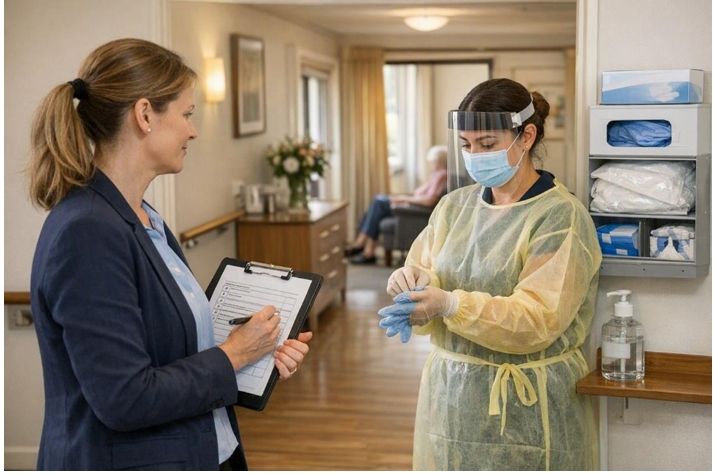
- PPE donning and doffing checks, ideally unannounced, to assess how staff perform under normal working conditions rather than in a rehearsed demonstration.
- Scenario-based discussions in which staff talk through how they would respond to a suspected outbreak, a needlestick injury, or a resident presenting with diarrhoea and vomiting.
- Supervisor sign-off confirming the staff member has been observed performing the skill correctly, not merely that they attended a session.
- Respirator fit-testing for staff using P2/N95 respirators - repeated at least annually where
organisational policy requires, whenever the respirator model changes, after significant
facial changes, or where an adequate seal cannot be achieved.
NB: Positive Reinforcement: When performing unannounced audits, ensure the feedback provided is supportive rather than punitive. This encourages transparency rather than fear, making staff more likely to seek help when they are unsure about a procedure.
Document every assessment. A documented pass, or a documented gap and the action taken to close it, is what turns a training calendar into an evidence portfolio an assessor can rely on; attendance records alone leave a facility far more exposed at accreditation.
How do you reach low-literacy and culturally and linguistically diverse (CALD) workforces?
Aged care in Australia and New Zealand is delivered by a genuinely diverse workforce, and IPC
education must meet people where they are. Demonstrations, pictorial job aids, bilingual
champions, and short, repeated practice sessions outperform text-heavy slide decks for staff
who are still developing English literacy or who learn better by doing than by reading.
Bilingual champions - trusted team members who can translate both language and cultural
context - are among the most effective tools available to a facility that cannot provide training in
every language spoken on shift. Pictorial job aids at the point of care, near hand basins, PPE
stations, and sluice rooms reinforce the message long after the session ends.
Person-centred IPC education also respects trauma and dignity, particularly when discussing
isolation precautions or PPE use with residents present.
What does a full IPC training matrix look like?
Different topics attract different audiences, occur at different frequencies, and have different
owners. Responsibility also sits at three levels: the organisation embeds training in its risk
framework and policies; the department or unit provides role-specific equipment and training;
and individual staff attend scheduled sessions, with attendance recorded in their training record.
The table below summarises the minimum requirements a RACF should build into its training
calendar.
| Topic | Target audience | Minimum frequency | Responsible |
| Hand hygiene Sharps safety |
All staff Clinical staff using sharps |
Orientation; annual refresher; after
outbreaks or new guidelines Orientation and when new devices are introduced; annual refresher in high-risk areas; after a needlestick incident |
IPC team Clinical Educator |
| Invasive devices | Staff inserting or managing devices | Orientation and when device technology changes; annual or biennial competency check; after an unexplained infection cluster | Clinical Educator |
| PPE use Respirator fit-testing |
Staff using PPE Staff using P2/N95 respirators |
Orientation and annually; when
new PPE is introduced; during a
respiratory outbreak At least annually (where required by organisational policy); change of respirator model; significant weight or facial changes |
IPC team IPC team |
| Antimicrobial stewardship (AMS) | Prescribers, pharmacists, nursing staff, residents and carers | Ongoing; annual or biennial refresh; new antimicrobials introduced; resistant-organism outbreaks | IPC Lead, medical advisor, pharmacist |
| Environmental cleaning | Cleaning and environmental services staff | Orientation and annually; new products, equipment, or protocols; after an outbreak | IPC team |
| Waste segregation and
handling Outbreak management |
All staff handling waste Outbreak team and relevant clinical staff |
Orientation and annually; policy
change; contamination event Orientation and annually; more frequent drills during active outbreak periods; after a declared outbreak |
IPC team IPC team |
| IPC Lead training | Designated IPC Lead | AU: ACQSC Alis platform on appointment, then AQF Level 8 within the ACQSC timeframe, plus ongoing CPD. NZ: no mandated specialist course. | ACQSC or external training provider |
Take-home message

Frequently asked questions
Are e-learning modules on the HUB acceptable as evidence?
External modules can supplement a facility program when mapped to local policies and paired
with a direct competency assessment. Modules on their own are evidence of attendance, not of
competency.
Who provides IPC training in small homes?
The IPC Lead or a trained champion delivers the core content, while the governing body
ensures staff are released from floor duties to attend. In very small homes, a train-the-trainer
approach allows the IPC Lead to upskill one champion per shift rather than trying to reach every
worker directly.
Who is responsible for organising IPC training?
Responsibility sits at three levels. The organisation embeds IPC training in its risk framework
and policies and reviews them annually or at a regulatory audit; the department or unit provides
role-specific equipment and training, such as PPE and sharps safety, for its team; and individual
staff are required to attend scheduled sessions, with attendance recorded in their training record
before they perform the relevant task.
What training must the IPC Lead complete?
In Australia, the IPC Lead completes IPC training via the Aged Care Quality and Safety
Commission's (ACQSC) Alis platform on appointment, then completes AQF Level 8 specialist
training within the timeframe set by the ACQSC, plus ongoing continuing professional
development (CPD). A certificate of completion and a CPD log are kept as evidence. New
Zealand has no equivalent mandated specialist qualification; the IPC program lead needs the
knowledge, skills, and competencies required for the role.
What training is required for outbreak roles?
Clearly define outbreak roles - coordinator, communications lead, cleaning lead, and staffing
lead - and run a tabletop exercise at least annually so each person has rehearsed their role
before a real outbreak begins. Update the training and the plan after every real outbreak,
capturing what worked and what did not.
Does New Zealand require different content?
Align training with NZS 8134:2021 Ngā Paerewa Health and Disability Services Standard, and
local public health guidance. The core precautions principles; hand hygiene, PPE, and
transmission-based precautions; are shared across Australia and New Zealand, even where
specific standards and reporting pathways differ.
How does training link to the Knowledge Hub?
Use cluster articles as reference material once foundational competency has been confirmed
through direct observation, not as a substitute for direct observation.
References and further reading
- ACSQHC Aged Care Infection Prevention and Control Guide (2025)
- Strengthened Aged Care Quality Standards (Australia)
- ACIPC Position Statements
- WHO Guidelines on Hand Hygiene
- Australian Guidelines for the Prevention and Control of Infection in Healthcare
- NZS 8134:2021 Ngā Paerewa
- Health NZ IPC resources
- IPS Knowledge Hub — IPC Education
Need an answer to that quick question?
Ask EVE or visit the HUB for more information.
Contact support@infectioncontrol.care for a more specific enquiry We are on Facebook and LinkedIn for regular updates – like and share
Ask EVE or visit the HUB for more information.
Contact support@infectioncontrol.care for a more specific enquiry We are on Facebook and LinkedIn for regular updates – like and share
Lyndon Forrest
Managing Director | CEO
Lyndon is the Managing Director of Infection Prevention Services (IPS), bringing over 30 years' experience supporting aged care providers across Australia and New Zealand.
With a background spanning outbreak response, compliance, and infection risk management — alongside hands-on experience leading teams, managing multi-site operations, and navigating business turnaround — he understands both the clinical and organisational pressures aged care providers face. Lyndon holds a Master of Commerce (Industrial Relations), and applies that foundation to the people, process, and growth challenges that come with running a complex healthcare services business.
He is passionate about building the systems and capability that make infection prevention sustainable — not just compliant — and about helping organisations grow their confidence alongside their practice.
Lyndon's focus is straightforward: strengthen operations, develop the right people, and drive proactive infection prevention strategies that protect residents, staff, and communities for the long term.
Lyndon is the Managing Director of Infection Prevention Services (IPS), bringing over 30 years' experience supporting aged care providers across Australia and New Zealand.
With a background spanning outbreak response, compliance, and infection risk management — alongside hands-on experience leading teams, managing multi-site operations, and navigating business turnaround — he understands both the clinical and organisational pressures aged care providers face. Lyndon holds a Master of Commerce (Industrial Relations), and applies that foundation to the people, process, and growth challenges that come with running a complex healthcare services business.
He is passionate about building the systems and capability that make infection prevention sustainable — not just compliant — and about helping organisations grow their confidence alongside their practice.
Lyndon's focus is straightforward: strengthen operations, develop the right people, and drive proactive infection prevention strategies that protect residents, staff, and communities for the long term.
Erica Callaghan
Marketing Manager
Erica Callaghan is a dedicated professional with a rich background in agriculture and nutrient management. Growing up on her family's farm in Mid Canterbury, she developed a deep passion for farming. She currently resides on her partner's arable property in South Canterbury.
In 2017, Erica joined the Farm Sustainability team, focusing on nutrient management and environmental stewardship. In February 2024, she became the Manager of Marketing and Sales at Bug Control New Zealand - Infection Prevention Services, where her passion now includes improving infection prevention outcomes.
Outside of work, Erica loves cooking and traveling, often combining her culinary interests with her explorations in Italy and Vietnam. She enjoys entertaining family and friends and remains actively involved in farm activities, especially during harvest season.
Erica Callaghan is a dedicated professional with a rich background in agriculture and nutrient management. Growing up on her family's farm in Mid Canterbury, she developed a deep passion for farming. She currently resides on her partner's arable property in South Canterbury.
In 2017, Erica joined the Farm Sustainability team, focusing on nutrient management and environmental stewardship. In February 2024, she became the Manager of Marketing and Sales at Bug Control New Zealand - Infection Prevention Services, where her passion now includes improving infection prevention outcomes.
Outside of work, Erica loves cooking and traveling, often combining her culinary interests with her explorations in Italy and Vietnam. She enjoys entertaining family and friends and remains actively involved in farm activities, especially during harvest season.
Toni Sherriff
Clinical Nurse Specialist
Toni is a Registered Nurse with extensive experience in Infection Prevention and Control. Her career began as a kitchen hand and caregiver in Aged Care facilities, followed by earning a Bachelor of Nursing.
Toni has significant experience, having worked in Brisbane’s Infectious Diseases ward before returning home to New Zealand, where she continued her career as a Clinical Nurse Specialist in Infection Prevention and Control within Te Whatu Ora (Health NZ).
Toni brings her expertise and dedication to our team, which is instrumental in providing top-tier infection prevention solutions to our clients.
Toni is a Registered Nurse with extensive experience in Infection Prevention and Control. Her career began as a kitchen hand and caregiver in Aged Care facilities, followed by earning a Bachelor of Nursing.
Toni has significant experience, having worked in Brisbane’s Infectious Diseases ward before returning home to New Zealand, where she continued her career as a Clinical Nurse Specialist in Infection Prevention and Control within Te Whatu Ora (Health NZ).
Toni brings her expertise and dedication to our team, which is instrumental in providing top-tier infection prevention solutions to our clients.
Julie Hadfield
Accounts & Payroll
Julie is experienced in Accounts & Payroll Administration & after a long career in both the Financial & Local Government Sectors, is now working with our team. Julie brings her strong time management & organisational skills to our team, which is important to keep the company running in the background to enable the rest of our team to provide top notch service to all of our clients.
Julie is experienced in Accounts & Payroll Administration & after a long career in both the Financial & Local Government Sectors, is now working with our team. Julie brings her strong time management & organisational skills to our team, which is important to keep the company running in the background to enable the rest of our team to provide top notch service to all of our clients.
Andrea Murray
Content Editor
I attended Otago University in NZ and graduated as a Dental Surgeon. After 40 years in the profession, I retired in 2022. Infection prevention knowledge was part of everyday practice, dealing with sterilisation, hand hygiene, and cleaning.
Before retiring, I began doing some editing and proofreading for Bug Control as I am interested in the subject and in the English language. During the COVID-19 lockdown, I attended the ACIPC course "Introduction to Infection Prevention and Control", which increased my interest in the subject. I now work part-time as the Content Editor for the company.
I attended Otago University in NZ and graduated as a Dental Surgeon. After 40 years in the profession, I retired in 2022. Infection prevention knowledge was part of everyday practice, dealing with sterilisation, hand hygiene, and cleaning.
Before retiring, I began doing some editing and proofreading for Bug Control as I am interested in the subject and in the English language. During the COVID-19 lockdown, I attended the ACIPC course "Introduction to Infection Prevention and Control", which increased my interest in the subject. I now work part-time as the Content Editor for the company.
Personally, I lived in the UK for 10 years. My two children were born in Scotland, and now both are living in Europe, one in Amsterdam, Netherlands, and the other in Edinburgh, Scotland. I live close to Fairlie on the South Island of NZ, a beautiful part of the country, and I love being out of the city.
Princess
Customer Support
Princess began her career as a dedicated Customer Service Representative, honing her communication and problem-solving skills. She later transitioned into a Literary Specialist role, where she developed a keen eye for detail. Her journey then led her to a Sales Specialist position, where she excelled in client relations.
Now, as a Customer Support professional in Infection Prevention Services. Princess focuses on ensuring customer satisfaction, building loyalty, and enhancing the overall customer journey.
Princess began her career as a dedicated Customer Service Representative, honing her communication and problem-solving skills. She later transitioned into a Literary Specialist role, where she developed a keen eye for detail. Her journey then led her to a Sales Specialist position, where she excelled in client relations.
Now, as a Customer Support professional in Infection Prevention Services. Princess focuses on ensuring customer satisfaction, building loyalty, and enhancing the overall customer journey.
Dianne Newey
Senior Infection Prevention and Control Consultant
Dianne is a Senior Clinical Consultant at Infection Prevention Services (IPS), bringing over 35 years of nursing experience and a depth of clinical knowledge that most people would need two careers to accumulate.
Having served as Clinical Director at Royal Ryde Rehabilitation Hospital alongside a career spanning the full breadth of clinical practice, Dianne has seen it all — and more importantly, knows exactly what to do about it. She is the person in the room that everyone quietly hopes will speak first.
For more than seven years she has been a cornerstone of the IPS team, providing clinical advice, developing and reviewing policies and procedures, delivering monthly IPC webinars to IP Leads, and conducting environmental audits in aged care facilities across Australia and New Zealand. If infection prevention has a question, Dianne almost certainly has the answer — and she'll deliver it with a laugh that you'll hear from the other end of the corridor.
A true fountain of knowledge, wrapped in the kind of warmth and humour that only three decades of nursing can produce. Customers don't just trust Dianne — they look forward to hearing from her.
Dianne is a Senior Clinical Consultant at Infection Prevention Services (IPS), bringing over 35 years of nursing experience and a depth of clinical knowledge that most people would need two careers to accumulate.
Having served as Clinical Director at Royal Ryde Rehabilitation Hospital alongside a career spanning the full breadth of clinical practice, Dianne has seen it all — and more importantly, knows exactly what to do about it. She is the person in the room that everyone quietly hopes will speak first.
For more than seven years she has been a cornerstone of the IPS team, providing clinical advice, developing and reviewing policies and procedures, delivering monthly IPC webinars to IP Leads, and conducting environmental audits in aged care facilities across Australia and New Zealand. If infection prevention has a question, Dianne almost certainly has the answer — and she'll deliver it with a laugh that you'll hear from the other end of the corridor.
A true fountain of knowledge, wrapped in the kind of warmth and humour that only three decades of nursing can produce. Customers don't just trust Dianne — they look forward to hearing from her.
Caoimhe (Keva) Stewart
Clinical & Business Operations Manager
Caoimhe is the Clinical & Business Operations Manager at Infection Prevention Services (IPS), bringing a clinical background as a Registered Nurse across the UK and Australia — and an almost unsettling ability to make technology do exactly what she wants.
With experience in Occupational Health, Palliative Care, and Community Nursing, she understands the real challenges faced by healthcare teams. What she may lack in stature she more than makes up for in impact — Caoimhe is the kind of person who walks into a problem, sizes it up, and has three solutions before anyone else has finished reading the brief.
Customers love her. Not just because she delivers — though she always does — but because she genuinely cares about the outcome on the other side. She is passionate about creating seamless learning experiences and empowering organisations with the tools, knowledge, and support needed to strengthen infection prevention practices and improve care outcomes.
Small in size. Mighty in results. Completely irreplaceable.
Caoimhe is the Clinical & Business Operations Manager at Infection Prevention Services (IPS), bringing a clinical background as a Registered Nurse across the UK and Australia — and an almost unsettling ability to make technology do exactly what she wants.
With experience in Occupational Health, Palliative Care, and Community Nursing, she understands the real challenges faced by healthcare teams. What she may lack in stature she more than makes up for in impact — Caoimhe is the kind of person who walks into a problem, sizes it up, and has three solutions before anyone else has finished reading the brief.
Customers love her. Not just because she delivers — though she always does — but because she genuinely cares about the outcome on the other side. She is passionate about creating seamless learning experiences and empowering organisations with the tools, knowledge, and support needed to strengthen infection prevention practices and improve care outcomes.
Small in size. Mighty in results. Completely irreplaceable.
Bridgette Mackie
Clinical Nurse Educator
Bridgette is an experienced New Zealand Registered Nurse, qualified Healthcare Auditor, and Healthcare Educator with a strong background in clinical quality, competency assessment, and infection prevention. She has led large-scale OSCE and CAP training programmes for internationally qualified nurses, developed sector-specific educational resources, and coordinated HealthCERT audit preparation in the surgical sector.
Known for her engaging teaching style and genuine passion for supporting learners, Bridgette excels at making complex topics accessible and relevant. She blends operational leadership with a deep commitment to professional development and safe, effective practice.
Bridgette is an experienced New Zealand Registered Nurse, qualified Healthcare Auditor, and Healthcare Educator with a strong background in clinical quality, competency assessment, and infection prevention. She has led large-scale OSCE and CAP training programmes for internationally qualified nurses, developed sector-specific educational resources, and coordinated HealthCERT audit preparation in the surgical sector.
Known for her engaging teaching style and genuine passion for supporting learners, Bridgette excels at making complex topics accessible and relevant. She blends operational leadership with a deep commitment to professional development and safe, effective practice.