
Jul 22
Winter Preparedness in Aged Care
Midwinter IPC Priorities for Your Facility – an Overview
Winter preparedness in aged care centres on infection prevention and control (IPC) strategies that
reduce respiratory outbreaks, protect residents, and ensure compliance with Australian and New
Zealand standards.
Key takeaways
- Winter is a high-risk period for respiratory infections in aged care, requiring early IPC planning
- Aged care providers must maintain an effective infection prevention and control system under the Strengthened Standards
- A designated IPC Lead role supports outbreak preparedness and coordination
- Cohorting, isolation, and hand hygiene remain core infection control measures
- New Zealand facilities must align with NZS 8134:2021 IPC programme requirements
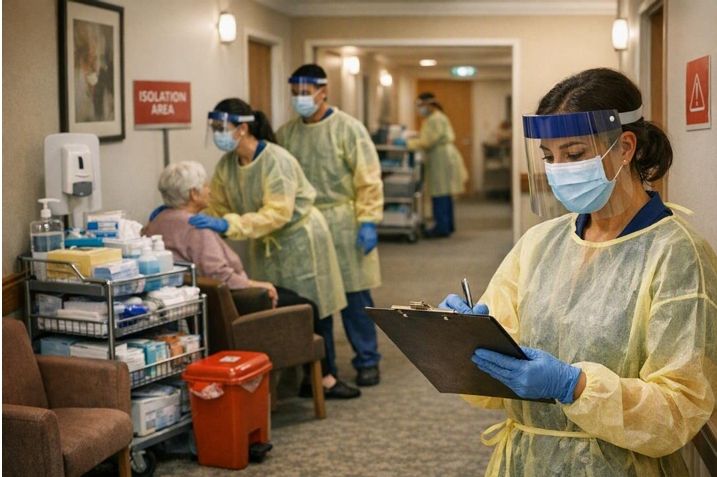
What are the midwinter IPC priorities for aged care?
Midwinter preparedness means having your outbreak plan, staff competencies, and supplies in
place before respiratory illness peaks. As an IPC Lead, focus on four things: a current outbreak
management plan, confident staff, adequate PPE and testing stock, and clear early-detection
processes. Prepare during the quiet period, so your team can respond quickly when cases appear.
Have you challenged your staff with an outbreak rehearsal?
Why does winter raise the IPC stakes in a facility?
Winter concentrates respiratory illness in the community, and residential aged care brings that
risk indoors, where residents live close together. Cold-season respiratory infections spread more
readily in shared settings, which is why facilities see clustering during the colder months.
Winter preparedness is the work you do before the peak: reviewing plans, restocking, and rehearsing your response to prevent an early case from escalating into a facility-wide outbreak.
The regulatory backdrop matters here. Under the Strengthened Aged Care Quality Standards (effective 1 November 2025), a facility must maintain an appropriate IPC system (Outcome 4.2). A well-run winter is a practical demonstration that the system works.
Winter preparedness is the work you do before the peak: reviewing plans, restocking, and rehearsing your response to prevent an early case from escalating into a facility-wide outbreak.
The regulatory backdrop matters here. Under the Strengthened Aged Care Quality Standards (effective 1 November 2025), a facility must maintain an appropriate IPC system (Outcome 4.2). A well-run winter is a practical demonstration that the system works.
What should your winter outbreak plan cover?
Your outbreak plan should be current, accessible, and understood by every shift. A plan written
last year but never rehearsed will not hold up in a real outbreak. Review it now, while your team
has capacity.
A workable midwinter plan covers the following elements.
- Early detection: a clear process for staff to report and escalate respiratory symptoms among residents and colleagues.
- Isolation and cohorting: cohorting involves grouping affected residents to limit transmission, and your plan should specify how and where you would do it.
- PPE readiness: current stock levels, correct donning and doffing procedures, and staff
trained in both.
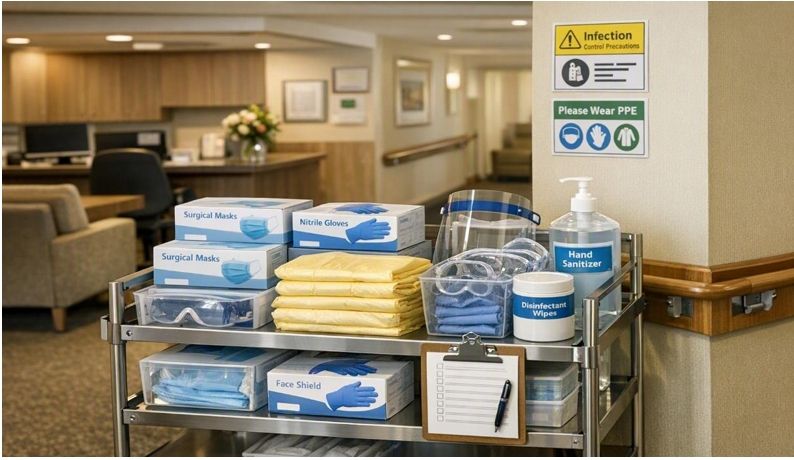
- Communication: who notifies families, staff, GPs, and the relevant public health unit, and when.
- Documentation: how you record cases, actions, and decisions for your evidence portfolio.
Keep the plan short enough that a nurse on a night shift can act on it without having to hunt for details.
How should you prepare your staff before the winter peak?
Prepare staff by confirming competence, not merely attendance. A signed training register does
not guarantee that a care worker can don and doff PPE correctly under pressure. Use the quiet
weeks to assess real skills.
Practical steps for the Director of Nursing and IPC Lead:
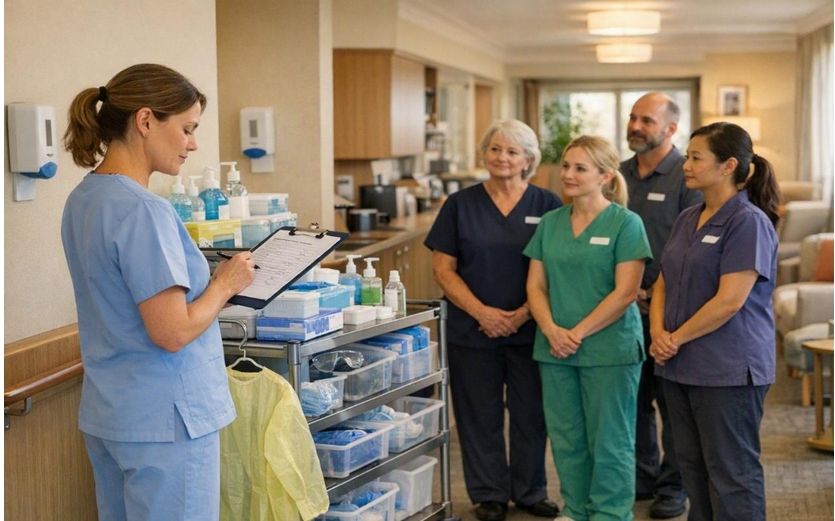
- Run a brief refresher on hand hygiene, PPE, and symptom recognition for every shift, including agency and night staff.
- Confirm that your IPC Lead has the capacity and authority to coordinate an outbreak response. A qualified IPC Lead is expected under the Strengthened Standards (Outcome 4.2).
- Complete a Training Needs Analysis (TiNA) to identify documented competence gaps before winter, not after an audit.
- Rehearse escalation so staff know exactly whom to call when the first resident presents
with symptoms.
On qualifications: AQF Level 8 is the recognised professional benchmark for the IPC Lead role, as
identified in regulator guidance (ACSQHC, 2024). It is not legislated under the Aged Care Act.
Focus on capability and role clarity rather than credentials alone.
What supplies and systems should you check now?
Check supplies before you need them. An outbreak is the wrong time to discover a PPE shortfall or
expired test stock. Build a simple pre-winter audit into your routine.
What to confirm before the peak of the season
- PPE: Adequate masks, gowns, gloves, and eye protection; staff trained in proper use.
- Testing: Sufficient point-of-care respiratory tests on hand and staff able to use them.
- Isolation capacity: A practical plan for where and how you would cohort affected residents.
- Vaccination: Resident and staff vaccination status reviewed and offered per current program guidance.
- Documentation: Outbreak logs, notification templates, and your evidence portfolio ready
to use.
Note: specific clinical protocols, product specifications, and vaccination schedules should be verified against current official guidance before finalising.
Frequently Asked Questions
When should we start preparing for winter in aged care?
Start before respiratory illness peaks in your region, ideally in the weeks leading up to midwinter. Preparing early gives your team capacity to review the outbreak plan, complete a Training Needs Analysis, restock PPE and testing supplies, and rehearse escalation. Preparing during an active outbreak is far harder and riskier.
Start before respiratory illness peaks in your region, ideally in the weeks leading up to midwinter. Preparing early gives your team capacity to review the outbreak plan, complete a Training Needs Analysis, restock PPE and testing supplies, and rehearse escalation. Preparing during an active outbreak is far harder and riskier.
What is cohorting and when do we use it?
Cohorting involves grouping affected residents to limit transmission during an outbreak. Your outbreak plan should specify in advance how and where you would cohort residents, so staff can act quickly when cases arise. Confirm your clinical approach against current official guidance.
Cohorting involves grouping affected residents to limit transmission during an outbreak. Your outbreak plan should specify in advance how and where you would cohort residents, so staff can act quickly when cases arise. Confirm your clinical approach against current official guidance.
Does the Director of Nursing run the outbreak response?
The Director of Nursing provides overall oversight, but a qualified IPC Lead is expected to coordinate the day-to-day IPC response. The Strengthened Standards (Outcome 4.2) expect a qualified IPC Lead role. Clarify these roles before winter to ensure accountability during an outbreak.
The Director of Nursing provides overall oversight, but a qualified IPC Lead is expected to coordinate the day-to-day IPC response. The Strengthened Standards (Outcome 4.2) expect a qualified IPC Lead role. Clarify these roles before winter to ensure accountability during an outbreak.
How does winter preparedness support Strengthened Standards compliance?
A well-run winter demonstrates that your IPC system works in practice. Under the Strengthened Aged Care Quality Standards (effective 1 November 2025), a facility must maintain an appropriate IPC system (Outcome 4.2). Your outbreak plan, staff competencies, and documentation all form part of that evidence.
A well-run winter demonstrates that your IPC system works in practice. Under the Strengthened Aged Care Quality Standards (effective 1 November 2025), a facility must maintain an appropriate IPC system (Outcome 4.2). Your outbreak plan, staff competencies, and documentation all form part of that evidence.
References
1. Australian Commission on Safety and Quality in Health Care (2024). Aged Care IPC Guide.
https://www.safetyandquality.gov.au/publications-and-resources/resource-library/aged-care-infection-prevention-and-control-guide
2. Aged Care Quality and Safety Commission. Strengthened Aged Care Quality Standards
(effective 1 November 2025). https://www.agedcarequality.gov.au/strengthened-quality
standards/environment/infection-prevention-and-control
3. Standards New Zealand. NZS 8134:2021 Ngā Paerewa Health and Disability Services Standard.
https://www.standards.govt.nz
Read more blogs on the IPC website; we do the research so you don’t have to.
We are present on social media sites, LinkedIn and Facebook, with short, factual posts. Be sure to follow for regular updates, like and share.
For a quick answer to an urgent question, use EVE – she has access to our website knowledge.
Or need to contact us directly? support@infectioncontrol.care
We are present on social media sites, LinkedIn and Facebook, with short, factual posts. Be sure to follow for regular updates, like and share.
For a quick answer to an urgent question, use EVE – she has access to our website knowledge.
Or need to contact us directly? support@infectioncontrol.care
Lyndon Forrest
Managing Director | CEO
Lyndon is the Managing Director of Infection Prevention Services (IPS), bringing over 30 years' experience supporting aged care providers across Australia and New Zealand.
With a background spanning outbreak response, compliance, and infection risk management — alongside hands-on experience leading teams, managing multi-site operations, and navigating business turnaround — he understands both the clinical and organisational pressures aged care providers face. Lyndon holds a Master of Commerce (Industrial Relations), and applies that foundation to the people, process, and growth challenges that come with running a complex healthcare services business.
He is passionate about building the systems and capability that make infection prevention sustainable — not just compliant — and about helping organisations grow their confidence alongside their practice.
Lyndon's focus is straightforward: strengthen operations, develop the right people, and drive proactive infection prevention strategies that protect residents, staff, and communities for the long term.
Lyndon is the Managing Director of Infection Prevention Services (IPS), bringing over 30 years' experience supporting aged care providers across Australia and New Zealand.
With a background spanning outbreak response, compliance, and infection risk management — alongside hands-on experience leading teams, managing multi-site operations, and navigating business turnaround — he understands both the clinical and organisational pressures aged care providers face. Lyndon holds a Master of Commerce (Industrial Relations), and applies that foundation to the people, process, and growth challenges that come with running a complex healthcare services business.
He is passionate about building the systems and capability that make infection prevention sustainable — not just compliant — and about helping organisations grow their confidence alongside their practice.
Lyndon's focus is straightforward: strengthen operations, develop the right people, and drive proactive infection prevention strategies that protect residents, staff, and communities for the long term.
Erica Callaghan
Marketing Manager
Erica Callaghan is a dedicated professional with a rich background in agriculture and nutrient management. Growing up on her family's farm in Mid Canterbury, she developed a deep passion for farming. She currently resides on her partner's arable property in South Canterbury.
In 2017, Erica joined the Farm Sustainability team, focusing on nutrient management and environmental stewardship. In February 2024, she became the Manager of Marketing and Sales at Bug Control New Zealand - Infection Prevention Services, where her passion now includes improving infection prevention outcomes.
Outside of work, Erica loves cooking and traveling, often combining her culinary interests with her explorations in Italy and Vietnam. She enjoys entertaining family and friends and remains actively involved in farm activities, especially during harvest season.
Erica Callaghan is a dedicated professional with a rich background in agriculture and nutrient management. Growing up on her family's farm in Mid Canterbury, she developed a deep passion for farming. She currently resides on her partner's arable property in South Canterbury.
In 2017, Erica joined the Farm Sustainability team, focusing on nutrient management and environmental stewardship. In February 2024, she became the Manager of Marketing and Sales at Bug Control New Zealand - Infection Prevention Services, where her passion now includes improving infection prevention outcomes.
Outside of work, Erica loves cooking and traveling, often combining her culinary interests with her explorations in Italy and Vietnam. She enjoys entertaining family and friends and remains actively involved in farm activities, especially during harvest season.
Toni Sherriff
Clinical Nurse Specialist
Toni is a Registered Nurse with extensive experience in Infection Prevention and Control. Her career began as a kitchen hand and caregiver in Aged Care facilities, followed by earning a Bachelor of Nursing.
Toni has significant experience, having worked in Brisbane’s Infectious Diseases ward before returning home to New Zealand, where she continued her career as a Clinical Nurse Specialist in Infection Prevention and Control within Te Whatu Ora (Health NZ).
Toni brings her expertise and dedication to our team, which is instrumental in providing top-tier infection prevention solutions to our clients.
Toni is a Registered Nurse with extensive experience in Infection Prevention and Control. Her career began as a kitchen hand and caregiver in Aged Care facilities, followed by earning a Bachelor of Nursing.
Toni has significant experience, having worked in Brisbane’s Infectious Diseases ward before returning home to New Zealand, where she continued her career as a Clinical Nurse Specialist in Infection Prevention and Control within Te Whatu Ora (Health NZ).
Toni brings her expertise and dedication to our team, which is instrumental in providing top-tier infection prevention solutions to our clients.
Julie Hadfield
Accounts & Payroll
Julie is experienced in Accounts & Payroll Administration & after a long career in both the Financial & Local Government Sectors, is now working with our team. Julie brings her strong time management & organisational skills to our team, which is important to keep the company running in the background to enable the rest of our team to provide top notch service to all of our clients.
Julie is experienced in Accounts & Payroll Administration & after a long career in both the Financial & Local Government Sectors, is now working with our team. Julie brings her strong time management & organisational skills to our team, which is important to keep the company running in the background to enable the rest of our team to provide top notch service to all of our clients.
Andrea Murray
Content Editor
I attended Otago University in NZ and graduated as a Dental Surgeon. After 40 years in the profession, I retired in 2022. Infection prevention knowledge was part of everyday practice, dealing with sterilisation, hand hygiene, and cleaning.
Before retiring, I began doing some editing and proofreading for Bug Control as I am interested in the subject and in the English language. During the COVID-19 lockdown, I attended the ACIPC course "Introduction to Infection Prevention and Control", which increased my interest in the subject. I now work part-time as the Content Editor for the company.
I attended Otago University in NZ and graduated as a Dental Surgeon. After 40 years in the profession, I retired in 2022. Infection prevention knowledge was part of everyday practice, dealing with sterilisation, hand hygiene, and cleaning.
Before retiring, I began doing some editing and proofreading for Bug Control as I am interested in the subject and in the English language. During the COVID-19 lockdown, I attended the ACIPC course "Introduction to Infection Prevention and Control", which increased my interest in the subject. I now work part-time as the Content Editor for the company.
Personally, I lived in the UK for 10 years. My two children were born in Scotland, and now both are living in Europe, one in Amsterdam, Netherlands, and the other in Edinburgh, Scotland. I live close to Fairlie on the South Island of NZ, a beautiful part of the country, and I love being out of the city.
Princess
Customer Support
Princess began her career as a dedicated Customer Service Representative, honing her communication and problem-solving skills. She later transitioned into a Literary Specialist role, where she developed a keen eye for detail. Her journey then led her to a Sales Specialist position, where she excelled in client relations.
Now, as a Customer Support professional in Infection Prevention Services. Princess focuses on ensuring customer satisfaction, building loyalty, and enhancing the overall customer journey.
Princess began her career as a dedicated Customer Service Representative, honing her communication and problem-solving skills. She later transitioned into a Literary Specialist role, where she developed a keen eye for detail. Her journey then led her to a Sales Specialist position, where she excelled in client relations.
Now, as a Customer Support professional in Infection Prevention Services. Princess focuses on ensuring customer satisfaction, building loyalty, and enhancing the overall customer journey.
Dianne Newey
Senior Infection Prevention and Control Consultant
Dianne is a Senior Clinical Consultant at Infection Prevention Services (IPS), bringing over 35 years of nursing experience and a depth of clinical knowledge that most people would need two careers to accumulate.
Having served as Clinical Director at Royal Ryde Rehabilitation Hospital alongside a career spanning the full breadth of clinical practice, Dianne has seen it all — and more importantly, knows exactly what to do about it. She is the person in the room that everyone quietly hopes will speak first.
For more than seven years she has been a cornerstone of the IPS team, providing clinical advice, developing and reviewing policies and procedures, delivering monthly IPC webinars to IP Leads, and conducting environmental audits in aged care facilities across Australia and New Zealand. If infection prevention has a question, Dianne almost certainly has the answer — and she'll deliver it with a laugh that you'll hear from the other end of the corridor.
A true fountain of knowledge, wrapped in the kind of warmth and humour that only three decades of nursing can produce. Customers don't just trust Dianne — they look forward to hearing from her.
Dianne is a Senior Clinical Consultant at Infection Prevention Services (IPS), bringing over 35 years of nursing experience and a depth of clinical knowledge that most people would need two careers to accumulate.
Having served as Clinical Director at Royal Ryde Rehabilitation Hospital alongside a career spanning the full breadth of clinical practice, Dianne has seen it all — and more importantly, knows exactly what to do about it. She is the person in the room that everyone quietly hopes will speak first.
For more than seven years she has been a cornerstone of the IPS team, providing clinical advice, developing and reviewing policies and procedures, delivering monthly IPC webinars to IP Leads, and conducting environmental audits in aged care facilities across Australia and New Zealand. If infection prevention has a question, Dianne almost certainly has the answer — and she'll deliver it with a laugh that you'll hear from the other end of the corridor.
A true fountain of knowledge, wrapped in the kind of warmth and humour that only three decades of nursing can produce. Customers don't just trust Dianne — they look forward to hearing from her.
Caoimhe (Keva) Stewart
Clinical & Business Operations Manager
Caoimhe is the Clinical & Business Operations Manager at Infection Prevention Services (IPS), bringing a clinical background as a Registered Nurse across the UK and Australia — and an almost unsettling ability to make technology do exactly what she wants.
With experience in Occupational Health, Palliative Care, and Community Nursing, she understands the real challenges faced by healthcare teams. What she may lack in stature she more than makes up for in impact — Caoimhe is the kind of person who walks into a problem, sizes it up, and has three solutions before anyone else has finished reading the brief.
Customers love her. Not just because she delivers — though she always does — but because she genuinely cares about the outcome on the other side. She is passionate about creating seamless learning experiences and empowering organisations with the tools, knowledge, and support needed to strengthen infection prevention practices and improve care outcomes.
Small in size. Mighty in results. Completely irreplaceable.
Caoimhe is the Clinical & Business Operations Manager at Infection Prevention Services (IPS), bringing a clinical background as a Registered Nurse across the UK and Australia — and an almost unsettling ability to make technology do exactly what she wants.
With experience in Occupational Health, Palliative Care, and Community Nursing, she understands the real challenges faced by healthcare teams. What she may lack in stature she more than makes up for in impact — Caoimhe is the kind of person who walks into a problem, sizes it up, and has three solutions before anyone else has finished reading the brief.
Customers love her. Not just because she delivers — though she always does — but because she genuinely cares about the outcome on the other side. She is passionate about creating seamless learning experiences and empowering organisations with the tools, knowledge, and support needed to strengthen infection prevention practices and improve care outcomes.
Small in size. Mighty in results. Completely irreplaceable.
Bridgette Mackie
Clinical Nurse Educator
Bridgette is an experienced New Zealand Registered Nurse, qualified Healthcare Auditor, and Healthcare Educator with a strong background in clinical quality, competency assessment, and infection prevention. She has led large-scale OSCE and CAP training programmes for internationally qualified nurses, developed sector-specific educational resources, and coordinated HealthCERT audit preparation in the surgical sector.
Known for her engaging teaching style and genuine passion for supporting learners, Bridgette excels at making complex topics accessible and relevant. She blends operational leadership with a deep commitment to professional development and safe, effective practice.
Bridgette is an experienced New Zealand Registered Nurse, qualified Healthcare Auditor, and Healthcare Educator with a strong background in clinical quality, competency assessment, and infection prevention. She has led large-scale OSCE and CAP training programmes for internationally qualified nurses, developed sector-specific educational resources, and coordinated HealthCERT audit preparation in the surgical sector.
Known for her engaging teaching style and genuine passion for supporting learners, Bridgette excels at making complex topics accessible and relevant. She blends operational leadership with a deep commitment to professional development and safe, effective practice.