
Nov 12
Diagnostic Stewardship in Aged Care: The Right Test at the Right Time
How diagnostic stewardship strengthens antimicrobial stewardship (AMS) in residential aged care across Australia and New Zealand
A positive urine dipstick does not always indicate an infection, and treating it as such is a common driver of unnecessary antibiotic prescriptions in aged care. Diagnostic stewardship means ordering the right test for the right resident at the right time, so the result leads to the right action. This blog is for infection prevention and control (IPC) Leads, nurses, care teams, and facility managers in residential aged care facilities (RACFs) across Australia and New Zealand. This blog focuses on what diagnostic stewardship is, how it supports your antimicrobial stewardship (AMS) program, when to test (and when not to), and how to collect samples so results can be trusted. At Infection Prevention Services (IPS), we see testing gaps in facilities every week, and we help teams close them through practical training, HUB resources, and IPC Lead support.
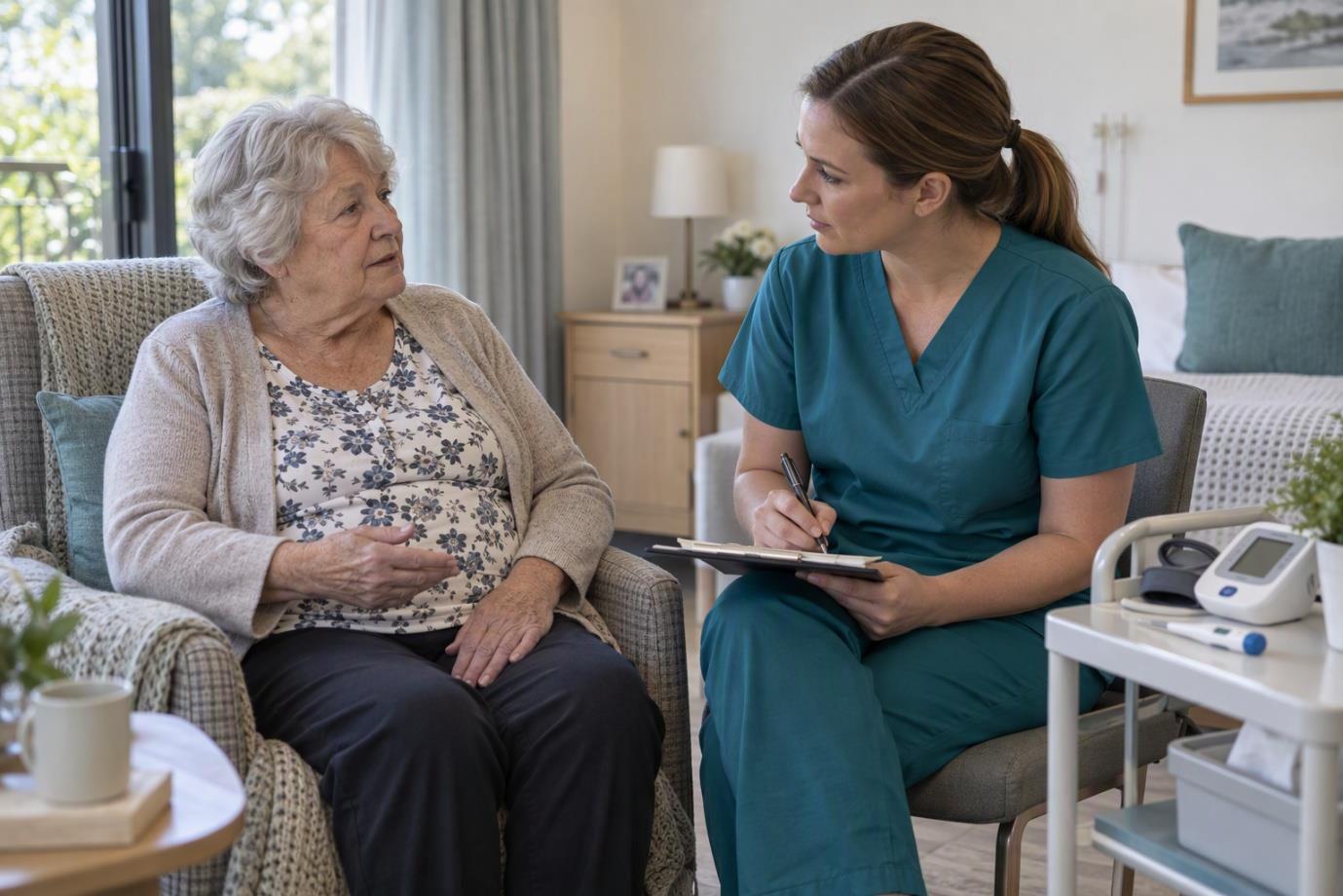
What Is Diagnostic Stewardship in Aged Care?
Diagnostic stewardship is the practice of choosing, collecting, and interpreting tests appropriately. In aged care, it covers urine tests, wound swabs, stool samples, respiratory swabs, and blood tests.
Think of it as the step before AMS. If the test is the wrong one, or is taken at the wrong time, the antibiotic decision that follows is likely to be wrong too.
How Does Diagnostic Stewardship Support Your AMS Program?
Every unnecessary test is a chance for an unnecessary antibiotic. Many older residents carry bacteria in their urine without infection; this is called asymptomatic bacteriuria (ASB). A dipstick or culture detects the bacteria, the result reads "positive", and an antibiotic is often prescribed.
The Australian data show how often this occurs:
The message is clear: test less, but test better, and your antibiotic use will fall with it.
Sources:Asymptomatic Bacteriuria Fact Sheet (ACSQHC and NCAS, 2020); Results of the 2023 Aged Care NAPS (Department of Health, Disability and Ageing, 2025)
The Australian data show how often this occurs:
- In 2018, ASB accounted for 2% of all antimicrobial prescriptions in Australian aged care, and four in five of those prescriptions were for prophylaxis.
- In the 2023 Aged Care National Antimicrobial Prescribing Survey (Aged Care NAPS), urinary tract infections (UTIs) accounted for 19.0% of suspected infections, only 36.1% of suspected infections met surveillance definitions for a confirmed infection.
The message is clear: test less, but test better, and your antibiotic use will fall with it.
Sources:Asymptomatic Bacteriuria Fact Sheet (ACSQHC and NCAS, 2020); Results of the 2023 Aged Care NAPS (Department of Health, Disability and Ageing, 2025)
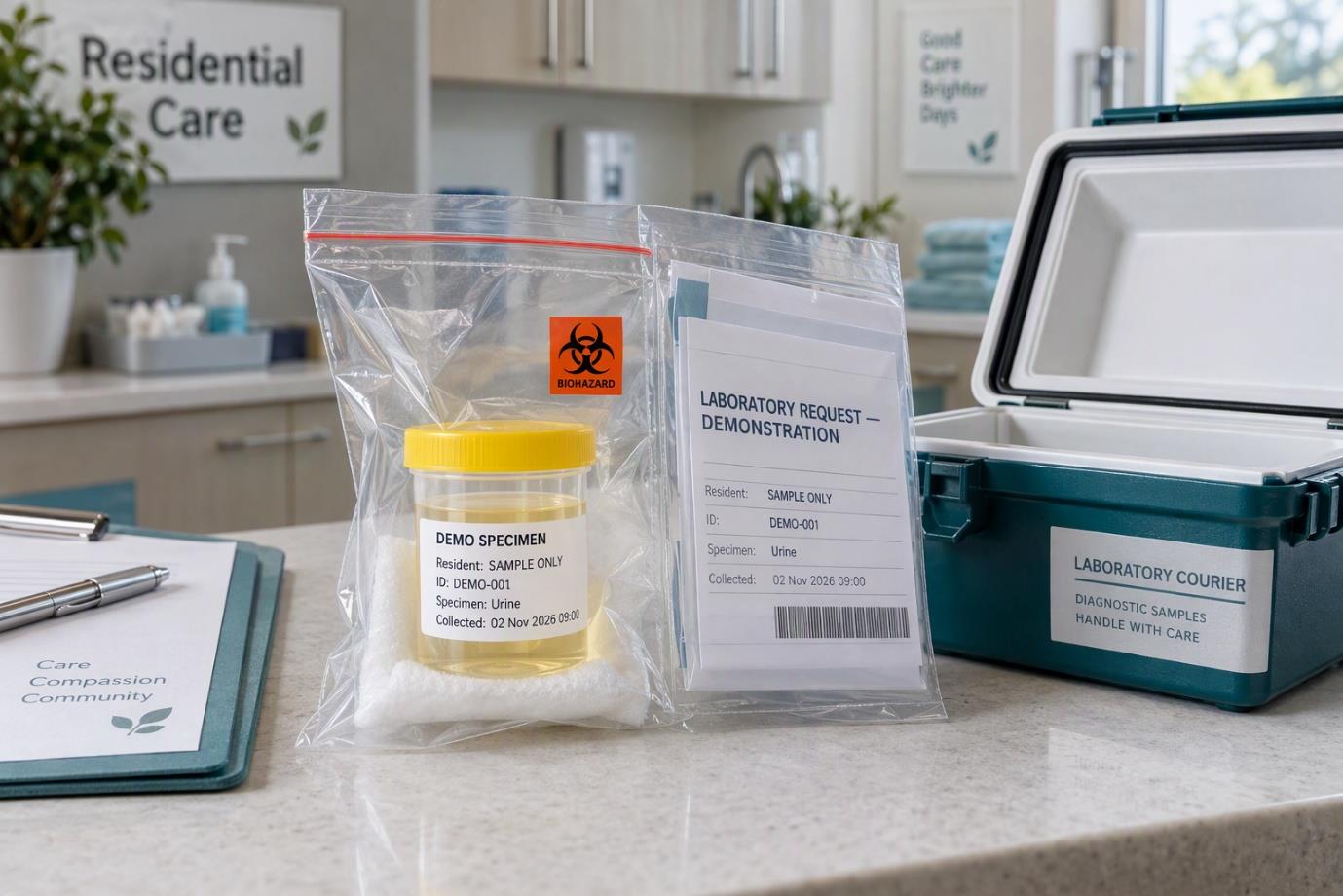
When Should Your Team Test — and When Should They Not?
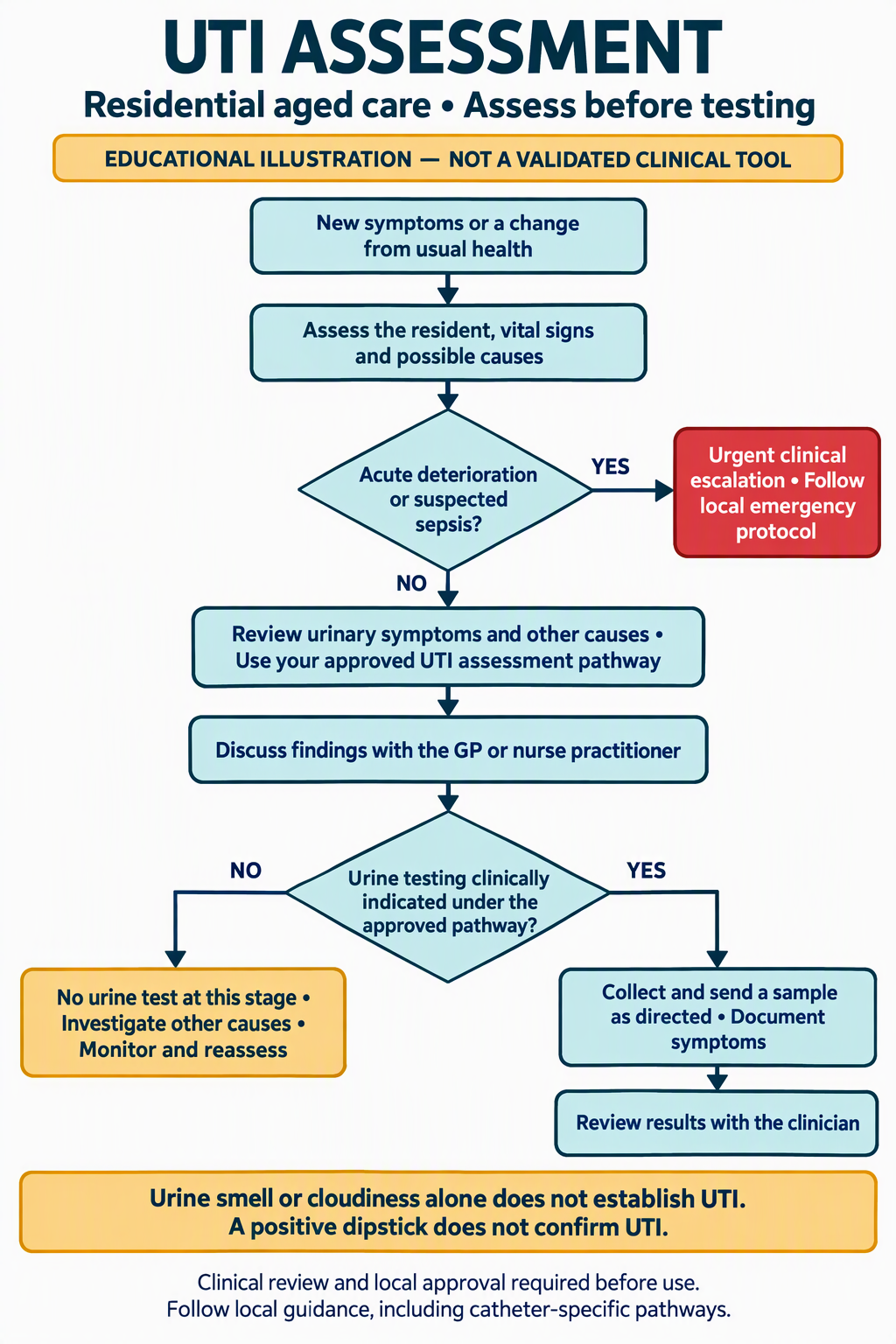
Test when a resident has signs or symptoms that suggest a specific infection, and when the result will change what you do.
A change in behaviour or new confusion is a symptom, not a diagnosis. Check vital signs and ask for clinical review the same day. Escalate straight away if the resident is unwell or deteriorating: fever, rigors, drowsiness, fast breathing, fast heart rate or low blood pressure can be early sepsis. While the review is arranged, look for other causes such as dehydration, constipation, pain, low oxygen and recent medication changes. Follow a pathway, not a dipstick.
Sources: Asymptomatic Bacteriuria Fact Sheet (ACSQHC and NCAS, 2020); Urinary Tract Infections Frailty Care Guide (HQSC, 2023)
| Sample | Test when | Do not test when |
| Urine | New burning or pain passing urine, urgency, frequency, suprapubic or flank pain, or fever with no other source and the resident has been clinically reviewed | Urine is cloudy or smelly, for routine admission screening, or as a "test of cure" after treatment |
| Wound swab | Spreading redness, heat, swelling, pus, or increasing pain | A chronic wound has no new signs of infection |
| Stool | Three or more loose stools (Bristol type 6–7) in 24 hours, or during a gastro outbreak | Stool is formed, or to "prove clearance" after treatment |
| Respiratory swab | New respiratory symptoms, or as directed in an outbreak |
A resident has no symptoms, and your outbreak plan does not require screening |
A change in behaviour or new confusion is a symptom, not a diagnosis. Check vital signs and ask for clinical review the same day. Escalate straight away if the resident is unwell or deteriorating: fever, rigors, drowsiness, fast breathing, fast heart rate or low blood pressure can be early sepsis. While the review is arranged, look for other causes such as dehydration, constipation, pain, low oxygen and recent medication changes. Follow a pathway, not a dipstick.
Sources: Asymptomatic Bacteriuria Fact Sheet (ACSQHC and NCAS, 2020); Urinary Tract Infections Frailty Care Guide (HQSC, 2023)
Why Does Timing Matter When Collecting Samples?
The right test at the wrong time yields a misleading result. Build these habits into your team's practice:
- Collect before the first antibiotic dose. Antibiotics given first can make culture results unreliable.
- Swab early in respiratory illness. Viral levels are usually highest during the first few days of symptoms.
- Get the urine to the lab promptly. Send it within two hours, or refrigerate it as your laboratory directs, to prevent bacterial multiplication in the container.
- Sample long-term catheters correctly. If the catheter has been in place more than 14 days, replace it first, then collect from the sampling port. Never collect from the drainage bag.
- Review at 48–72 hours. When results return, use them to stop, narrow the antibiotic spectrum, or continue the antibiotic.
What Do the Australian and New Zealand Standards Expect?
In Australia, the Strengthened Aged Care Quality Standards (effective 1 November 2025) place AMS under Outcome 5.2: Preventing and controlling infections in delivering clinical care services. Action 5.2.1 requires providers to implement an AMS system, and the Aged Care Quality and Safety Commission (ACQSC) directs providers to the AMS Clinical Care Standard for evidence-based practice. Appropriate testing provides clear evidence that your AMS system works day to day, and the AMS Self-Assessment Tool (AMS SAT) helps you demonstrate it.
In New Zealand, NZS 8134:2021, the Ngā Paerewa Health and Disability Services Standard, includes infection prevention and AMS in Section 5, with subsection 5.3 covering your AMS programme and how you implement it. The Health Quality & Safety Commission (HQSC) frailty care guide on UTIs provides aged residential care teams with practical assessment guidance.
Sources: Strengthened Aged Care Quality Standards, Outcome 5.2 (ACQSC, 2025); Guidance for Implementation of the AMS Clinical Care Standard in Aged Care (ACSQHC, 2024); NZS 8134:2021 Ngā Paerewa (Standards New Zealand, 2021)
How Can Your Facility Start Diagnostic Stewardship This Month?
- Remove urine dipsticks from routine use for residents without urinary symptoms.
- Adopt a UTI assessment pathway, such as the Aged Care Quality and Safety Commission's To Dip or Not to Dip clinical pathway for suspected UTI (with and without a catheter). In New Zealand, use the HQSC UTI frailty care guide.
- Use ISBAR to report symptoms to the GP or nurse practitioner, not just a "positive dipstick".
- Train your care team in the correct collection techniques for urine, wound, stool, and respiratory samples.
- Talk with families about why not every change in behaviour requires a urine test.
- Audit specimens sent each month against your testing criteria and report results to your AMS committee.
How Can IPS Help Your Team Get the Right Test at the Right Time?
Infection Prevention Services (IPS) helps aged care facilities across Australia and New Zealand stop infections and use antibiotics wisely. We support your diagnostic stewardship and AMS program with:
- HUB — policies, procedures, checklists, and quick IPC audits, ready for your next audit.
- In-person training — practical sessions on recognising infection and correctly collecting samples, with monthly reporting.
- IPC Lead training and mentoring — so your IPC Lead can guide testing decisions with confidence.
- Flipcharts — quick bedside reminders your care team can use on every shift.
- Registration (AU) and certification (NZ) preparation — evidence that your AMS system maps to Outcome 5.2 and NZS 8134:2021.
Frequently Asked Questions
What is diagnostic stewardship in aged care?
Diagnostic stewardship means ordering the right test for the right resident at the right time, so the result leads to the right treatment decision.
Should aged care residents have routine urine dipstick tests?
No. Screening for and treating asymptomatic bacteriuria in older people is not recommended. Test only when a resident has urinary symptoms or fever without another source.
How does diagnostic stewardship support AMS?
Fewer unnecessary tests mean fewer "positive" results that lead to antibiotics a resident doesn't need, reducing side effects and antimicrobial resistance.
What do the standards require for AMS in aged care?
In Australia, Action 5.2.1 of the Strengthened Aged Care Quality Standards requires an AMS system. In New Zealand, NZS 8134:2021, subsection 5.3, covers the AMS program.
Take-Home Message
Moving from reactive testing to proactive assessment protects your residents, reduces antibiotic harm, and shows assessors your AMS program works. Don't let a dipstick make the decision!
Read more of our blogs on the IPS website, the HUB.
For a regular snippet of news, we are on LinkedIn and Facebook. Like us and share the post with others
For a regular snippet of news, we are on LinkedIn and Facebook. Like us and share the post with others
For a quick question, ask EVE, our multilingual bot or to contact us, email support@infectioncontrol.care
Lyndon Forrest
Managing Director | CEO
Lyndon is the Managing Director of Infection Prevention Services (IPS), bringing over 30 years' experience supporting aged care providers across Australia and New Zealand.
With a background spanning outbreak response, compliance, and infection risk management — alongside hands-on experience leading teams, managing multi-site operations, and navigating business turnaround — he understands both the clinical and organisational pressures aged care providers face. Lyndon holds a Master of Commerce (Industrial Relations), and applies that foundation to the people, process, and growth challenges that come with running a complex healthcare services business.
He is passionate about building the systems and capability that make infection prevention sustainable — not just compliant — and about helping organisations grow their confidence alongside their practice.
Lyndon's focus is straightforward: strengthen operations, develop the right people, and drive proactive infection prevention strategies that protect residents, staff, and communities for the long term.
Erica Callaghan
Marketing Manager
Erica Callaghan is a dedicated professional with a rich background in agriculture and nutrient management. Growing up on her family's farm in Mid Canterbury, she developed a deep passion for farming. She currently resides on her partner's arable property in South Canterbury.
In 2017, Erica joined the Farm Sustainability team, focusing on nutrient management and environmental stewardship. In February 2024, she became the Manager of Marketing and Sales at Bug Control New Zealand - Infection Prevention Services, where her passion now includes improving infection prevention outcomes.
Outside of work, Erica loves cooking and traveling, often combining her culinary interests with her explorations in Italy and Vietnam. She enjoys entertaining family and friends and remains actively involved in farm activities, especially during harvest season.
Toni Sherriff
Clinical Nurse Specialist
Toni is a Registered Nurse with extensive experience in Infection Prevention and Control. Her career began as a kitchen hand and caregiver in Aged Care facilities, followed by earning a Bachelor of Nursing.
Toni has significant experience, having worked in Brisbane’s Infectious Diseases ward before returning home to New Zealand, where she continued her career as a Clinical Nurse Specialist in Infection Prevention and Control within Te Whatu Ora (Health NZ).
Toni brings her expertise and dedication to our team, which is instrumental in providing top-tier infection prevention solutions to our clients.
Julie Hadfield
Accounts & Payroll
Julie is experienced in Accounts & Payroll Administration & after a long career in both the Financial & Local Government Sectors, is now working with our team. Julie brings her strong time management & organisational skills to our team, which is important to keep the company running in the background to enable the rest of our team to provide top notch service to all of our clients.
Andrea Murray
Content Editor
I attended Otago University in NZ and graduated as a Dental Surgeon. After 40 years in the profession, I retired in 2022. Infection prevention knowledge was part of everyday practice, dealing with sterilisation, hand hygiene, and cleaning.
Before retiring, I began doing some editing and proofreading for Bug Control as I am interested in the subject and in the English language. During the COVID-19 lockdown, I attended the ACIPC course "Introduction to Infection Prevention and Control", which increased my interest in the subject. I now work part-time as the Content Editor for the company.
Personally, I lived in the UK for 10 years. My two children were born in Scotland, and now both are living in Europe, one in Amsterdam, Netherlands, and the other in Edinburgh, Scotland. I live close to Fairlie on the South Island of NZ, a beautiful part of the country, and I love being out of the city.
Princess
Customer Support
Princess began her career as a dedicated Customer Service Representative, honing her communication and problem-solving skills. She later transitioned into a Literary Specialist role, where she developed a keen eye for detail. Her journey then led her to a Sales Specialist position, where she excelled in client relations.
Now, as a Customer Support professional in Infection Prevention Services. Princess focuses on ensuring customer satisfaction, building loyalty, and enhancing the overall customer journey.
Dianne Newey
Senior Infection Prevention and Control Consultant
Dianne is a Senior Clinical Consultant at Infection Prevention Services (IPS), bringing over 35 years of nursing experience and a depth of clinical knowledge that most people would need two careers to accumulate.
Having served as Clinical Director at Royal Ryde Rehabilitation Hospital alongside a career spanning the full breadth of clinical practice, Dianne has seen it all — and more importantly, knows exactly what to do about it. She is the person in the room that everyone quietly hopes will speak first.
For more than seven years she has been a cornerstone of the IPS team, providing clinical advice, developing and reviewing policies and procedures, delivering monthly IPC webinars to IP Leads, and conducting environmental audits in aged care facilities across Australia and New Zealand. If infection prevention has a question, Dianne almost certainly has the answer — and she'll deliver it with a laugh that you'll hear from the other end of the corridor.
A true fountain of knowledge, wrapped in the kind of warmth and humour that only three decades of nursing can produce. Customers don't just trust Dianne — they look forward to hearing from her.
Caoimhe (Keva) Stewart
Clinical & Business Operations Manager
Caoimhe is the Clinical & Business Operations Manager at Infection Prevention Services (IPS), bringing a clinical background as a Registered Nurse across the UK and Australia — and an almost unsettling ability to make technology do exactly what she wants.
With experience in Occupational Health, Palliative Care, and Community Nursing, she understands the real challenges faced by healthcare teams. What she may lack in stature she more than makes up for in impact — Caoimhe is the kind of person who walks into a problem, sizes it up, and has three solutions before anyone else has finished reading the brief.
Customers love her. Not just because she delivers — though she always does — but because she genuinely cares about the outcome on the other side. She is passionate about creating seamless learning experiences and empowering organisations with the tools, knowledge, and support needed to strengthen infection prevention practices and improve care outcomes.
Small in size. Mighty in results. Completely irreplaceable.
Bridgette Mackie
Clinical Nurse Educator
Bridgette is an experienced New Zealand Registered Nurse, qualified Healthcare Auditor, and Healthcare Educator with a strong background in clinical quality, competency assessment, and infection prevention. She has led large-scale OSCE and CAP training programmes for internationally qualified nurses, developed sector-specific educational resources, and coordinated HealthCERT audit preparation in the surgical sector.
Known for her engaging teaching style and genuine passion for supporting learners, Bridgette excels at making complex topics accessible and relevant. She blends operational leadership with a deep commitment to professional development and safe, effective practice.