
Nov 2
Explaining IPC to Residents in Aged Care: A Plain-Language Guide
Simple, respectful ways to talk about infection prevention and control with residents
Masks, hand gel, isolation, and visitor restrictions can be confusing, even upsetting, for residents if they aren't explained. This guide is for everyone working in residential aged care in Australia and New Zealand: nurses, care workers, cleaners, and the kitchen, laundry, lifestyle, and reception teams. You'll learn why explaining Infection Prevention and Control (IPC) to residents matters, which everyday words to use instead of jargon, and how to adapt your message for residents living with dementia, hearing loss, or limited English. At Infection Prevention Services (IPS), we train aged care teams across both countries every month, and one lesson comes up again and again: a clear, kind conversation with a resident is one of the simplest infection prevention tools you have.

Why Should You Explain IPC to Residents?
Residents don't visit your facility; they live there. When we change their routine without explanation, it can feel like something is being done to them rather than with them. A resident who understands why you're wearing a mask is more likely to stay calm, ask questions, and follow simple steps, such as washing their hands before meals.
It's also about their rights. The Strengthened Aged Care Quality Standards (effective 1 November 2025) place the older person at the centre of care, including their right to clear information and to make their own choices. In New Zealand, Ngā Paerewa expects services to share infection prevention information with residents and whānau in a way they can understand.
Sources: Strengthened Aged Care Quality Standards (Aged Care Quality and Safety Commission, 2025); NZS 8134:2021 Ngā Paerewa Health and Disability Services Standard (Standards New Zealand, 2021)
What Does Plain Language Mean in Aged Care?
Plain language uses everyday words, short sentences, and one idea at a time. It isn't "talking down”; residents have lived full lives and deserve to be addressed as adults.
- Before you start, use the resident's name and make eye contact.
- Say what you're doing, why you're doing it, and what it means to them.
- Swap clinical words for everyday ones.
- Check understanding by asking them to explain it in their own words.
What Words Can You Use Instead of IPC Jargon?
The words we use every shift can sound like a foreign language to residents. Try these alternatives.
| Instead of | Try saying |
| Infection prevention and control | "The things we do to stop germs spreading" |
| Hand hygiene | "Washing or cleaning our hands" |
| Personal protective equipment (PPE) | "A mask, gloves, and apron to keep you and me safe" |
| Isolation or transmission-based precautions | "Staying in your room for a few days so the bug doesn't spread to your friends" |
| Outbreak | "A few people here have the same bug at the moment" |
| Respiratory infection | "A chest or throat bug, like a cold or the flu" |
| Gastroenteritis | "A tummy bug" |
| Vaccination | "Your flu jab helps your body fight the bug" |
How Do You Explain PPE Without Worrying Residents?
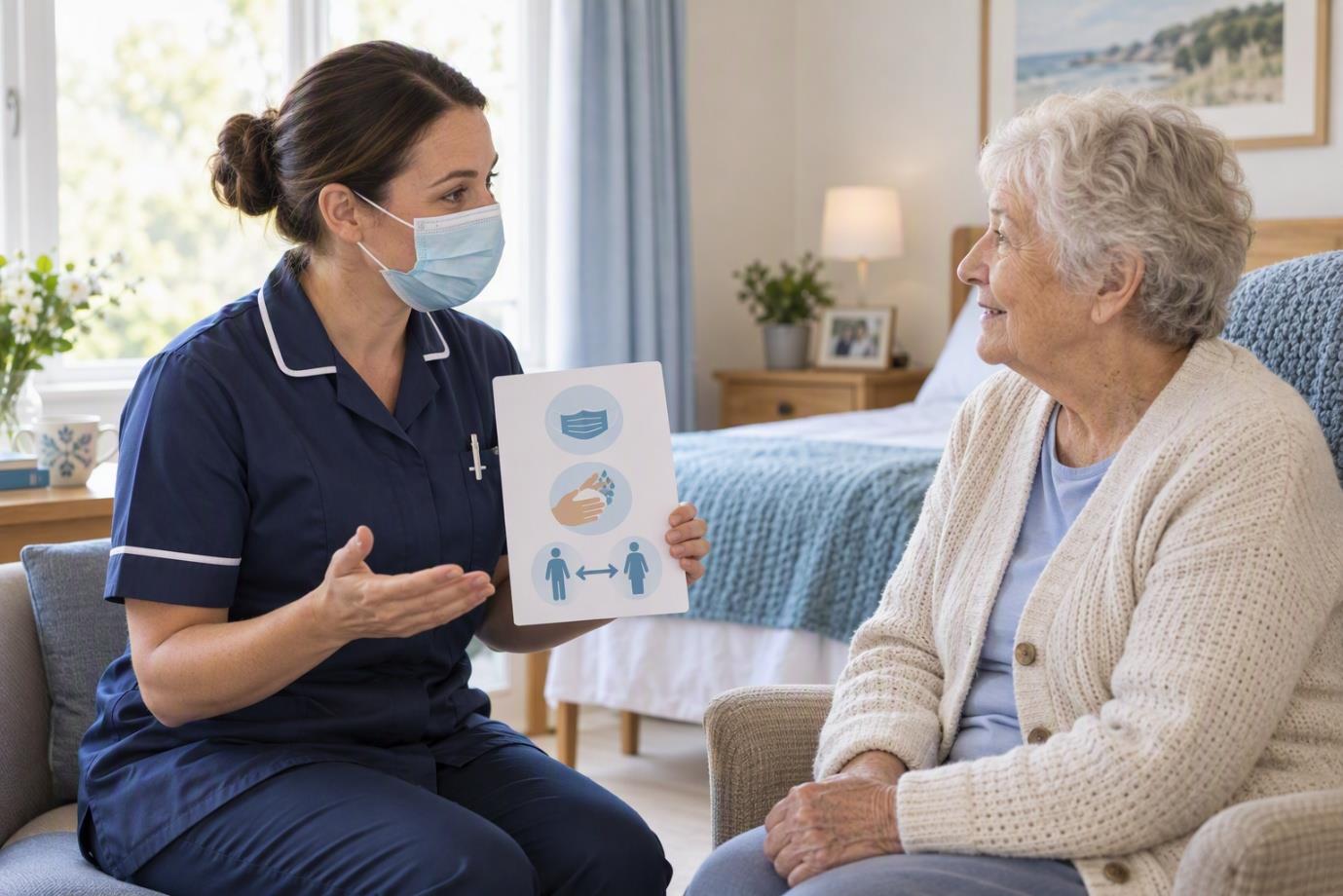
A mask hides your smile and muffles your voice. For some residents, especially those living with dementia, a masked face can be frightening. Introduce yourself and explain before you enter or put on PPE.
For example: "Hi Mary, it's Rebecca. I'm wearing a mask today because a few people have a cold. It's to keep you safe; I'm not sick." A smiling photo badge on your uniform also helps residents recognise who is behind the mask.

How Can You Explain Isolation Kindly?
Being asked to stay in your room can feel like a punishment. Be honest about why it's necessary and how long it will likely last.
- Tell the resident what will remain the same, such as meals, care, and their favourite radio program.
- Offer phone or video calls with family and whānau.
- Pop in for a chat, not just for care tasks.
- Update them each day so they're never left guessing.
How Do You Adapt the Message for Different Residents?
Every resident is different, so adjust how you explain things.
- Residents living with dementia: Use short sentences, give one step at a time, and show rather than tell — clean your hands alongside them. Repeat calmly as often as needed.
- Residents with hearing loss: Face them, reduce background noise, and use picture cards or written notes.
- Residents with low vision: Describe out loud what you're going to do before you do it.
- Culturally and linguistically diverse (CALD) residents: use accredited interpreters where available for important discussions, with family involvement based on the resident's wishes.
- Māori residents: Involve whānau in discussions and respect tikanga, such as keeping food separate from personal belongings.
What If a Resident Says No?
Residents have the right to make choices, including saying no to a vaccine or to staying in their room. Stay calm, listen to their concerns, and try explaining it differently. Never argue, threaten, or force the issue.
Let the Registered Nurse or IPC Lead know straight away. They can work with the resident, family, and GP to develop a plan that respects the resident's choice and keeps everyone safe. Document the conversation in the resident's notes.
Take-Home Message
Explaining IPC to residents isn't just a nurse's job — every team member, from care to cleaning to the kitchen, can do it. When residents understand what's happening and why, they feel respected, worry less, and are more likely to participate and cooperate. Don't wait for an outbreak to start the
Read more of our blogs on the IPS website, the HUB.
For a regular snippet of news, we are on LinkedIn and Facebook. Like us and share the post with others
For a regular snippet of news, we are on LinkedIn and Facebook. Like us and share the post with others
For a quick question, ask EVE, our multilingual bot or to contact us, email support@infectioncontrol.care
Lyndon Forrest
Managing Director | CEO
Lyndon is the Managing Director of Infection Prevention Services (IPS), bringing over 30 years' experience supporting aged care providers across Australia and New Zealand.
With a background spanning outbreak response, compliance, and infection risk management — alongside hands-on experience leading teams, managing multi-site operations, and navigating business turnaround — he understands both the clinical and organisational pressures aged care providers face. Lyndon holds a Master of Commerce (Industrial Relations), and applies that foundation to the people, process, and growth challenges that come with running a complex healthcare services business.
He is passionate about building the systems and capability that make infection prevention sustainable — not just compliant — and about helping organisations grow their confidence alongside their practice.
Lyndon's focus is straightforward: strengthen operations, develop the right people, and drive proactive infection prevention strategies that protect residents, staff, and communities for the long term.
Erica Callaghan
Marketing Manager
Erica Callaghan is a dedicated professional with a rich background in agriculture and nutrient management. Growing up on her family's farm in Mid Canterbury, she developed a deep passion for farming. She currently resides on her partner's arable property in South Canterbury.
In 2017, Erica joined the Farm Sustainability team, focusing on nutrient management and environmental stewardship. In February 2024, she became the Manager of Marketing and Sales at Bug Control New Zealand - Infection Prevention Services, where her passion now includes improving infection prevention outcomes.
Outside of work, Erica loves cooking and traveling, often combining her culinary interests with her explorations in Italy and Vietnam. She enjoys entertaining family and friends and remains actively involved in farm activities, especially during harvest season.
Toni Sherriff
Clinical Nurse Specialist
Toni is a Registered Nurse with extensive experience in Infection Prevention and Control. Her career began as a kitchen hand and caregiver in Aged Care facilities, followed by earning a Bachelor of Nursing.
Toni has significant experience, having worked in Brisbane’s Infectious Diseases ward before returning home to New Zealand, where she continued her career as a Clinical Nurse Specialist in Infection Prevention and Control within Te Whatu Ora (Health NZ).
Toni brings her expertise and dedication to our team, which is instrumental in providing top-tier infection prevention solutions to our clients.
Julie Hadfield
Accounts & Payroll
Julie is experienced in Accounts & Payroll Administration & after a long career in both the Financial & Local Government Sectors, is now working with our team. Julie brings her strong time management & organisational skills to our team, which is important to keep the company running in the background to enable the rest of our team to provide top notch service to all of our clients.
Andrea Murray
Content Editor
I attended Otago University in NZ and graduated as a Dental Surgeon. After 40 years in the profession, I retired in 2022. Infection prevention knowledge was part of everyday practice, dealing with sterilisation, hand hygiene, and cleaning.
Before retiring, I began doing some editing and proofreading for Bug Control as I am interested in the subject and in the English language. During the COVID-19 lockdown, I attended the ACIPC course "Introduction to Infection Prevention and Control", which increased my interest in the subject. I now work part-time as the Content Editor for the company.
Personally, I lived in the UK for 10 years. My two children were born in Scotland, and now both are living in Europe, one in Amsterdam, Netherlands, and the other in Edinburgh, Scotland. I live close to Fairlie on the South Island of NZ, a beautiful part of the country, and I love being out of the city.
Princess
Customer Support
Princess began her career as a dedicated Customer Service Representative, honing her communication and problem-solving skills. She later transitioned into a Literary Specialist role, where she developed a keen eye for detail. Her journey then led her to a Sales Specialist position, where she excelled in client relations.
Now, as a Customer Support professional in Infection Prevention Services. Princess focuses on ensuring customer satisfaction, building loyalty, and enhancing the overall customer journey.
Dianne Newey
Senior Infection Prevention and Control Consultant
Dianne is a Senior Clinical Consultant at Infection Prevention Services (IPS), bringing over 35 years of nursing experience and a depth of clinical knowledge that most people would need two careers to accumulate.
Having served as Clinical Director at Royal Ryde Rehabilitation Hospital alongside a career spanning the full breadth of clinical practice, Dianne has seen it all — and more importantly, knows exactly what to do about it. She is the person in the room that everyone quietly hopes will speak first.
For more than seven years she has been a cornerstone of the IPS team, providing clinical advice, developing and reviewing policies and procedures, delivering monthly IPC webinars to IP Leads, and conducting environmental audits in aged care facilities across Australia and New Zealand. If infection prevention has a question, Dianne almost certainly has the answer — and she'll deliver it with a laugh that you'll hear from the other end of the corridor.
A true fountain of knowledge, wrapped in the kind of warmth and humour that only three decades of nursing can produce. Customers don't just trust Dianne — they look forward to hearing from her.
Caoimhe (Keva) Stewart
Clinical & Business Operations Manager
Caoimhe is the Clinical & Business Operations Manager at Infection Prevention Services (IPS), bringing a clinical background as a Registered Nurse across the UK and Australia — and an almost unsettling ability to make technology do exactly what she wants.
With experience in Occupational Health, Palliative Care, and Community Nursing, she understands the real challenges faced by healthcare teams. What she may lack in stature she more than makes up for in impact — Caoimhe is the kind of person who walks into a problem, sizes it up, and has three solutions before anyone else has finished reading the brief.
Customers love her. Not just because she delivers — though she always does — but because she genuinely cares about the outcome on the other side. She is passionate about creating seamless learning experiences and empowering organisations with the tools, knowledge, and support needed to strengthen infection prevention practices and improve care outcomes.
Small in size. Mighty in results. Completely irreplaceable.
Bridgette Mackie
Clinical Nurse Educator
Bridgette is an experienced New Zealand Registered Nurse, qualified Healthcare Auditor, and Healthcare Educator with a strong background in clinical quality, competency assessment, and infection prevention. She has led large-scale OSCE and CAP training programmes for internationally qualified nurses, developed sector-specific educational resources, and coordinated HealthCERT audit preparation in the surgical sector.
Known for her engaging teaching style and genuine passion for supporting learners, Bridgette excels at making complex topics accessible and relevant. She blends operational leadership with a deep commitment to professional development and safe, effective practice.