
Nov 2
Managing Cytotoxic Medicines in Residential Aged Care: A Practical Guide for Staff
Health risks, common medicines, and practical precautions for residential aged care teams in Australia and New Zealand
Cytotoxic medicines are no longer confined to oncology wards. More aged care residents now take them for cancer, rheumatoid arthritis, psoriasis, and blood disorders - and every nurse, carer, cleaner, and laundry worker who handles the medicine or the resident's body fluids may be exposed. This guide from IPS (Infection Prevention Services) outlines the health risks for healthcare workers (HCWs), the cytotoxic drugs most encountered in Australian and New Zealand facilities, and the controls management needs to implement. It's written for IPC Leads, facility managers, nurses, and support staff seeking clear, practical steps to protect themselves and their colleagues.
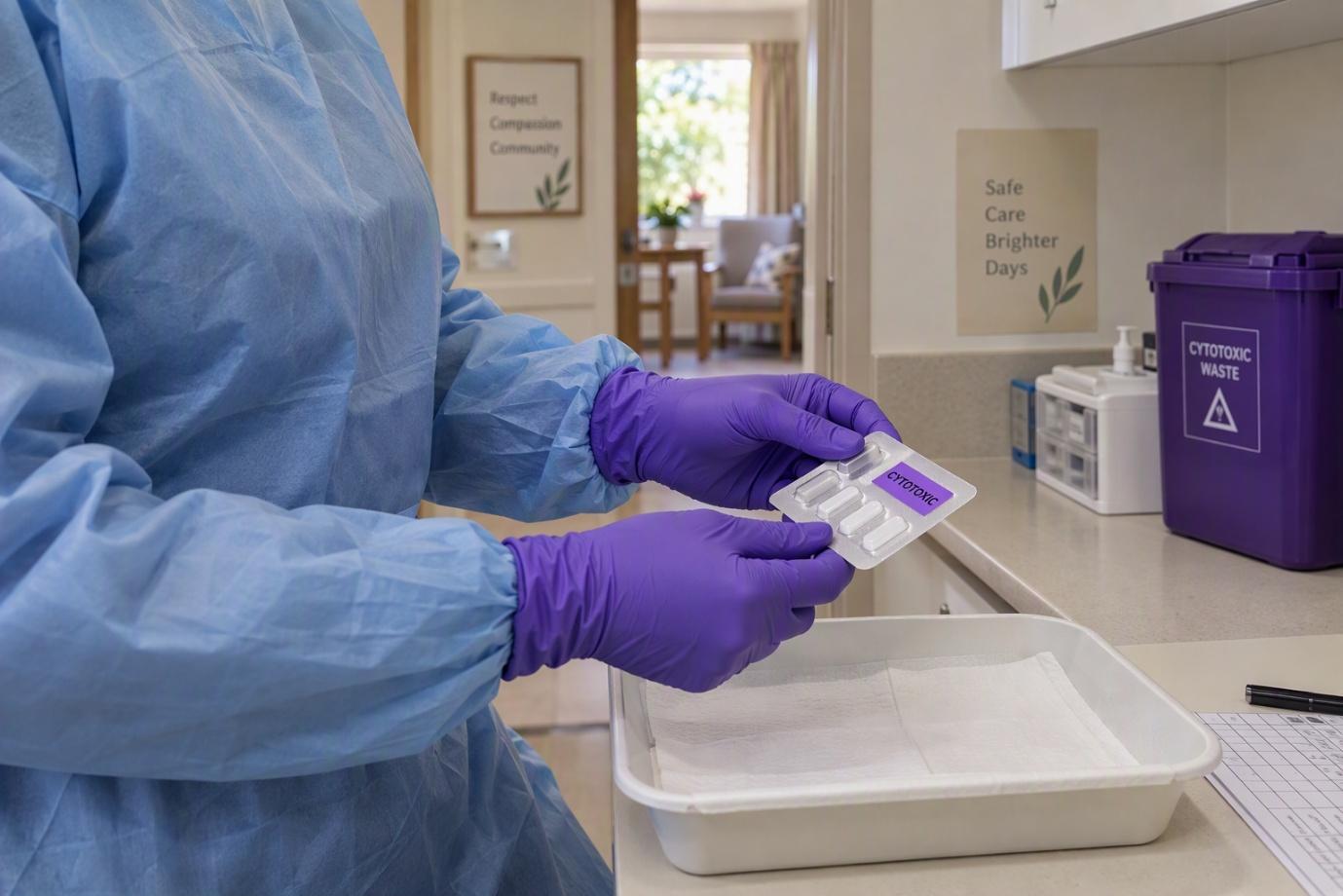
Why Are Cytotoxic Drugs a Risk to Aged Care Staff?
Cytotoxic drugs work by damaging cells or preventing them from dividing. This makes them effective against cancer and autoimmune disease but also increases the risk to the people who handle them. The Australasian College for Infection Prevention and Control (ACIPC) describes them as sensitising, mutagenic, carcinogenic, or toxic to reproduction.
Staff can be exposed in four ways:
In aged care, the biggest risk often isn't administering the medicine. It's managing what comes after. Drugs and their breakdown products can be present in urine, faeces, vomit and other body fluids for up to seven days after a dose. The period varies by drug. Follow eviQ and the prescriber or pharmacist's advice for each resident's medicine, and treat any resident on a cytotoxic as 'on precautions' until you have confirmed the end date.
Continence care, a soiled bed change, or a bathroom clean are all exposure points.
Staff can be exposed in four ways:
- Skin contact — touching tablets, creams, contaminated surfaces, or bodily fluids.
- Inhalation — breathing in drug particles or vapours from waste.
- Ingestion — hand-to-mouth transfer after contact with contaminated items.
- Injection — needlestick injuries from contaminated sharps.
In aged care, the biggest risk often isn't administering the medicine. It's managing what comes after. Drugs and their breakdown products can be present in urine, faeces, vomit and other body fluids for up to seven days after a dose. The period varies by drug. Follow eviQ and the prescriber or pharmacist's advice for each resident's medicine, and treat any resident on a cytotoxic as 'on precautions' until you have confirmed the end date.
Continence care, a soiled bed change, or a bathroom clean are all exposure points.
What Health Effects Should Healthcare Workers Be Aware Of?
Effects range from immediate to long-term.
No safe workplace exposure level has been set for these drugs, and repeated low-level exposure adds up over time. Facilities should have a documented risk assessment and redeployment process for workers who are pregnant, breastfeeding, or planning pregnancy.
- Short-term — skin and eye irritation, rashes, allergic reactions, nausea, and headaches.
- Reproductive — reduced fertility, miscarriage, and birth defects. WorkSafe New Zealand states that exposure can cause miscarriage and birth defects.
- Long-term — increased risk of some cancers, including blood cancers. Danish cancer registry studies reported elevated leukaemia rates among oncology nurses from the 1970s onwards.
No safe workplace exposure level has been set for these drugs, and repeated low-level exposure adds up over time. Facilities should have a documented risk assessment and redeployment process for workers who are pregnant, breastfeeding, or planning pregnancy.
Which Cytotoxic Drugs Are Most Common in Australian and New Zealand Aged Care?
Use is increasing in residential care as these medicines are prescribed for more conditions. Common examples include:
Some facilities also apply cytotoxic precautions to immunosuppressants such as azathioprine and mycophenolate. Hormonal cancer treatments such as tamoxifen and anastrozole aren't cytotoxic but are classified as hazardous drugs, so pregnant staff should avoid handling them. Check each resident's medicines against the eviQ hazardous drugs table and ask your pharmacist if you're unsure.
| Medicine | What It's Used For | Form |
| Methotrexate | Rheumatoid arthritis, psoriasis, and some cancers | Weekly tablet or injection |
| Hydroxyurea (hydroxycarbamide) | Blood disorders such as polycythaemia vera and some leukaemias | Capsule |
| Capecitabine | Bowel and breast cancer | Tablet |
| Fluorouracil 5% cream | Sun damage (solar keratoses) and some superficial skin cancers | Topical cream |
| Chlorambucil | Chronic lymphocytic leukaemia and lymphoma | Tablet |
| Cyclophosphamide (oral) | Some cancers and severe autoimmune conditions | Tablet |
Some facilities also apply cytotoxic precautions to immunosuppressants such as azathioprine and mycophenolate. Hormonal cancer treatments such as tamoxifen and anastrozole aren't cytotoxic but are classified as hazardous drugs, so pregnant staff should avoid handling them. Check each resident's medicines against the eviQ hazardous drugs table and ask your pharmacist if you're unsure.
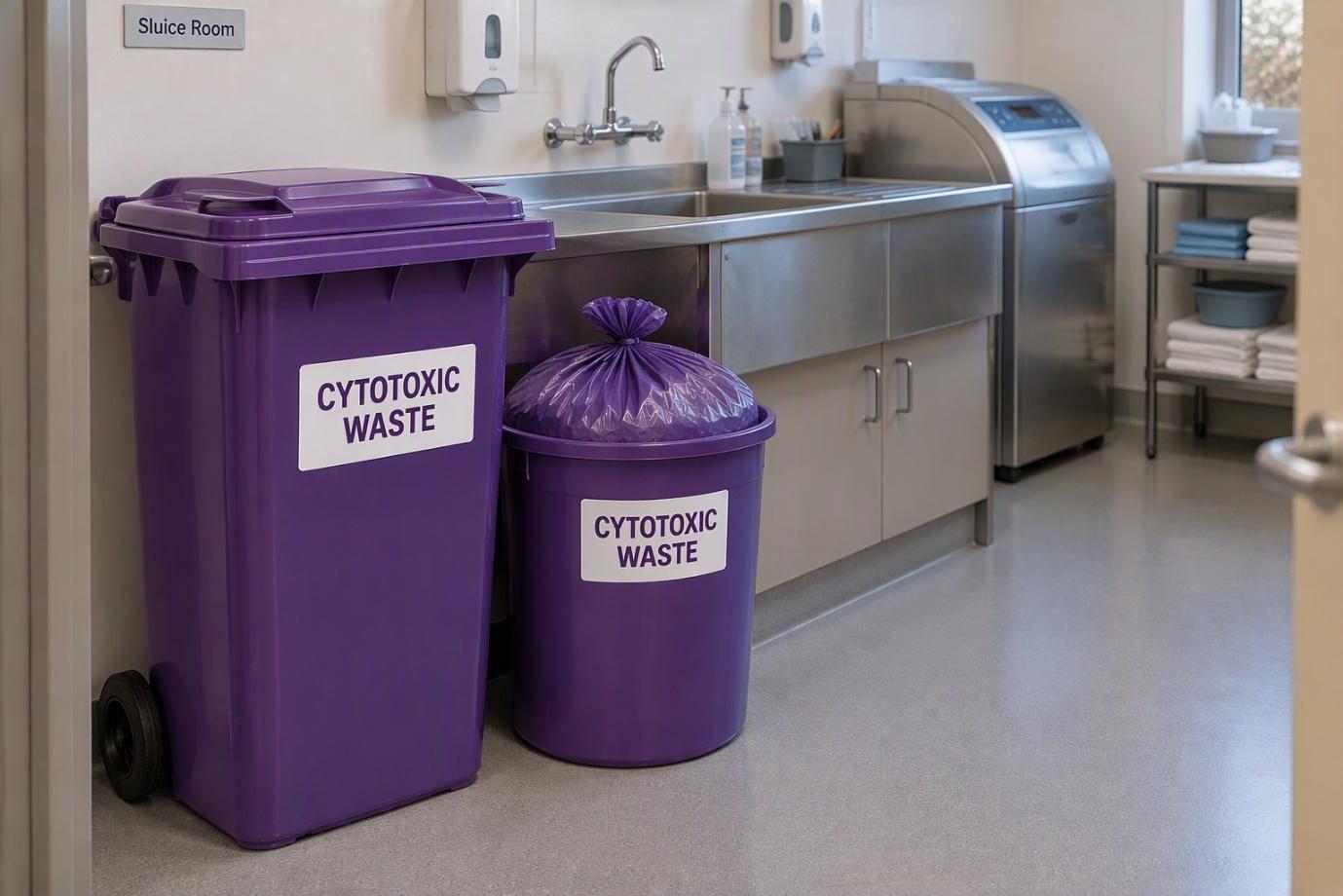
What Precautions Should Management Put in Place?
Under work health and safety laws in Australia (for example the model Work Health and Safety Act 2011 and the WHS Regulation, or the equivalent in your state) and the Health and Safety at Work Act 2015 in New Zealand, employers must identify and control hazardous drug risks. The Strengthened Aged Care Quality Standards (from 1 November 2025) and Ngā Paerewa NZS 8134:2021 also expect safe systems for clinical care, medication management and worker safety.
Management checklist
☐ Complete a cytotoxic risk assessment and management plan for each resident, covering administration, body waste, laundry, clinical waste, and staff precautions.
☐ Clearly flag the resident with purple cytotoxic labels (purple is the colour used by many AU facilities; use your facility and waste contractor colours) on the medication chart, care plan, and specimen forms — and inform every staff member entering the room, including cleaning, laundry, and kitchen teams.
☐ Restrict administration to staff who are trained and competent in cytotoxic handling and are authorised under your medication policy and scope of practice, ideally on a separate round from routine medication.
☐ Store cytotoxic medicines separately, labelled, in a locked area.
☐ Never crush or split cytotoxic tablets. Apply creams using a disposable spatula or gloved application as directed by the pharmacist.
☐ Stock the appropriate PPE: chemotherapy-tested nitrile gloves (ASTM D6978), long-sleeved waterproof gowns, P2/N95 masks, and eye protection.
☐ Place a cytotoxic spill kit in every sluice and pan room.
☐ Train all staff — eviQ's free online modules are a good starting point.
☐ Maintain a written policy for pregnant and breastfeeding staff, including redeployment options.
☐ Report every exposure or spill as an incident. After skin or eye exposure, wash skin with soap and water, flush eyes for at least 15 minutes, report it and seek review.
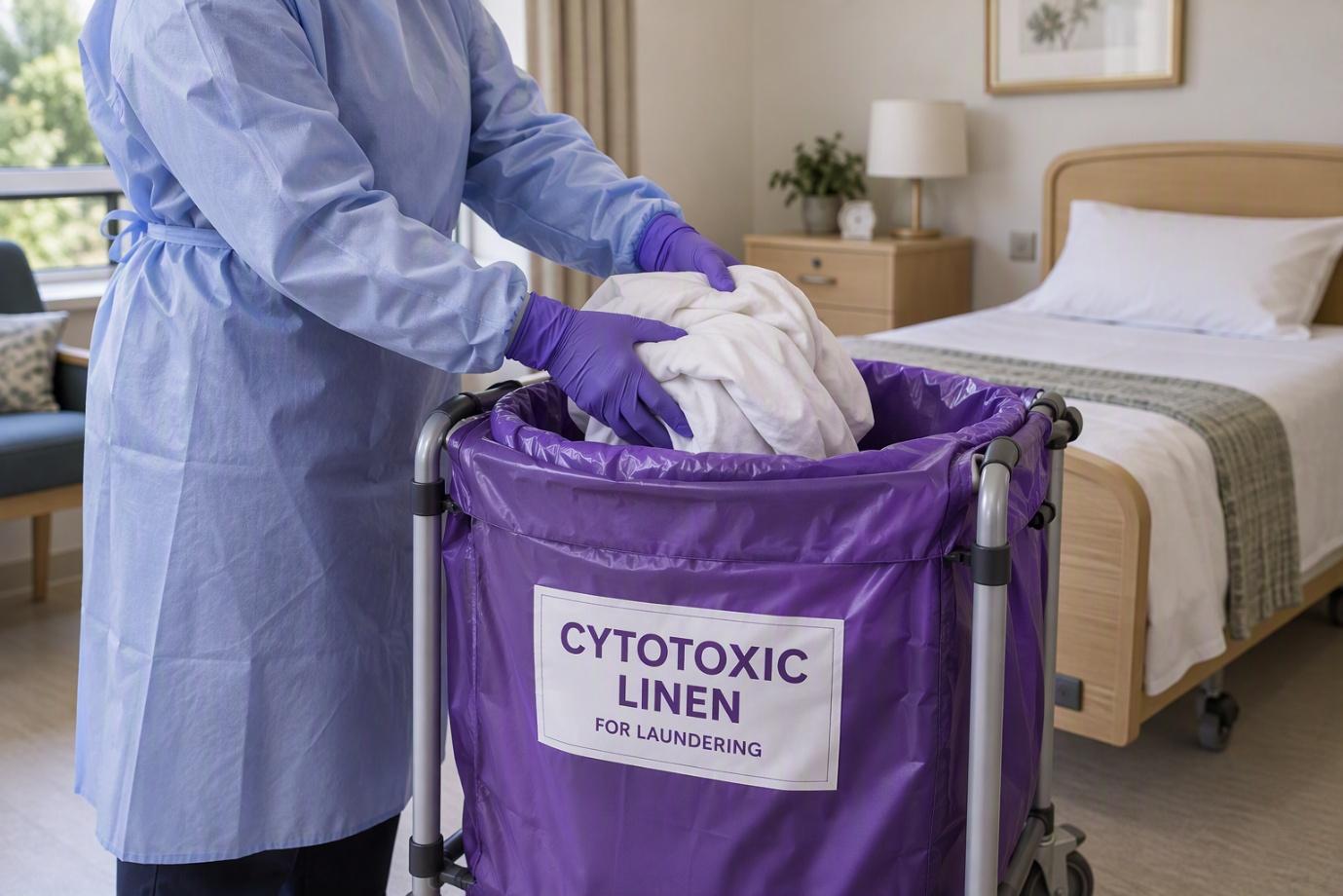
What Do Kitchen, Laundry, and Cleaning Staff Need to Do?
Support staff are often the last to learn that a resident is on cytotoxics; yet they handle some of the most contaminated items.
Laundry
Linen without body-fluid contamination is washed normally. Contaminated linen is bagged at the point of care in a purple soluble bag, then placed inside a purple linen bag, stored separately, and washed on a hot cycle (71°C for three minutes) or an ozone cycle. Staff wear a long-sleeved gown, gloves, a P2/N95 mask, and eye protection. The laundry requires its own cytotoxic waste bin.
Cleaning
Bedrooms and common areas require standard cleaning. Additional precautions are required for higher-risk areas, particularly bathrooms and toilets, and for any area affected by a spill. Use disposable cloths and mops where possible, or designated purple equipment, and bag used cloths in purple soluble bags at the point of cleaning. For spills, care staff contain and clean up first; cleaners then disinfect. Flush toilets twice with the lid down.
Kitchen and Food Service
Food service staff face a lower but still present risk of exposure. They should know which residents require precautions, wear gloves when collecting trays or crockery contaminated with vomit or saliva, and report spills without attempting to clean them up. Never crush cytotoxic tablets into food.
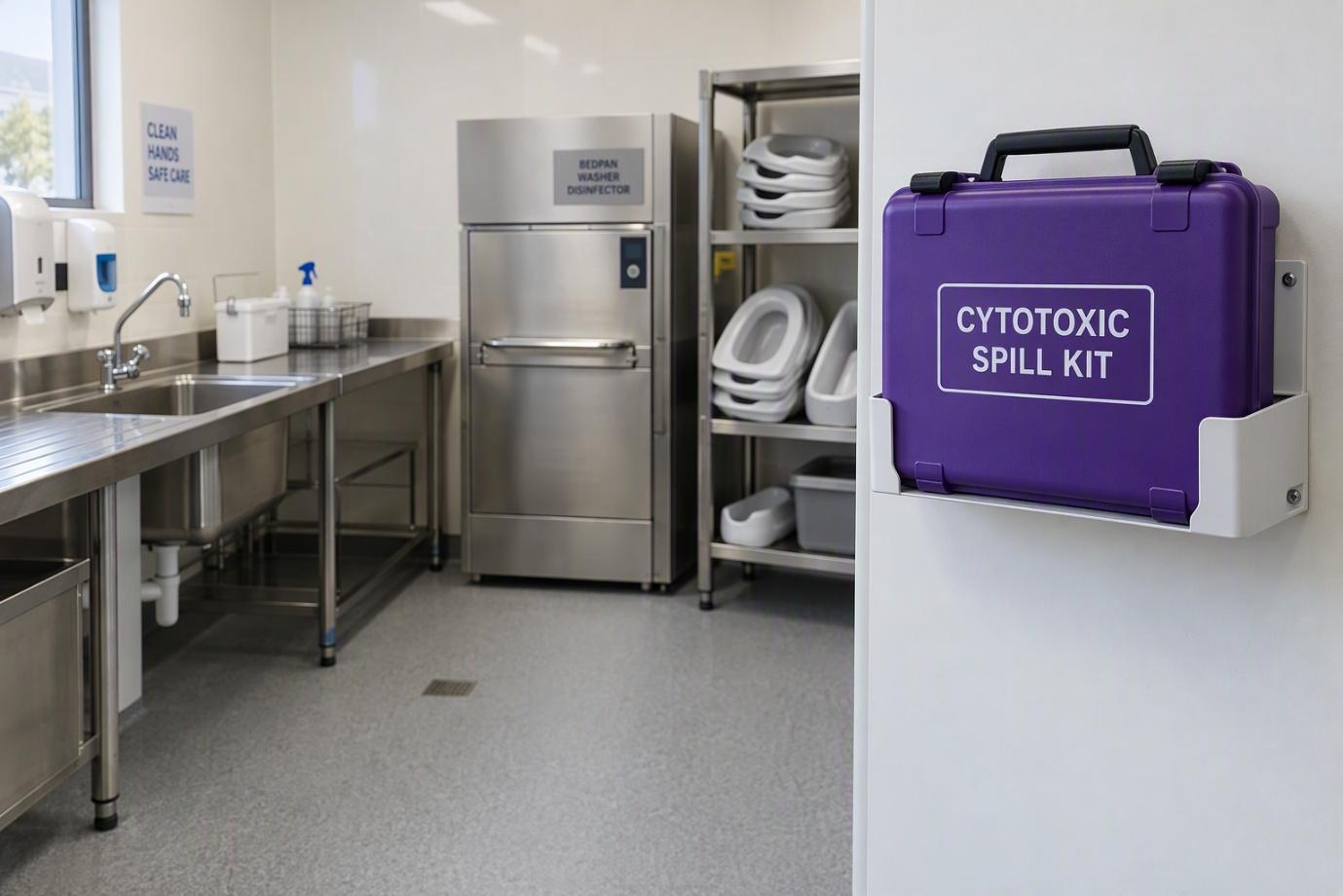
How Will Staff Know a Resident Is Receiving Cytotoxic Medication?
Facilities should have a clear identification process that alerts all relevant staff, including nursing, care, cleaning, laundry, and food-service staff. The process should be reflected in care plans, medication records, handovers, and any local alert systems so appropriate precautions can be taken consistently.
Has a Healthcare Worker Ever Been Harmed by Cytotoxic Exposure?
Yes. The best-known case is a warning for any setting where staff think, "it's only a small amount".
Sue Crump spent 23 years preparing chemotherapy as a hospital pharmacist in the United States, mostly before safety guidelines existed. Spills were wiped up with paper towels and thrown in the rubbish. She was diagnosed with pancreatic cancer and died in 2009, aged 55. Several former colleagues also developed cancers and other serious illnesses. Canadian nurse Sally Giles, who also worked extensively with chemotherapy, died of bile duct cancer in 1992.
Linking a single cancer to workplace exposure is difficult, but Sue's story led to two worker-safety laws in Washington State. Research shows exposure remains common: in a US survey of 1,339 oncology nurses, nearly 17% reported skin or eye exposure, with exposures higher where staffing and resources were stretched — a familiar picture in aged care.
Frequently Asked Questions
How long do cytotoxic precautions last after a dose?
eviQ uses a standard timeframe of up to seven days after each dose. Some medicines need a shorter or longer period, so confirm the end date for each resident's medicine with the pharmacist or prescriber and record it in the care plan.
Can pregnant staff care for residents on cytotoxic drugs?
They should not administer cytotoxic drugs or handle body fluids, waste, or contaminated linen from residents under precautions.
How should cytotoxic laundry be washed in aged care?
Bag contaminated linen at the point of care in a purple soluble bag, then place it inside a purple linen bag. Store and wash it separately on a hot (71°C for three minutes) or on an ozone cycle.
Take-Home Message
Cytotoxic medicines are now part of everyday aged care, and the risk extends well beyond the medication round. Clear resident alerts, appropriate PPE, separate waste and laundry streams, and trained staff protect everyone entering that room. IPS (Infection Prevention Services) supports facilities across Australia and New Zealand with ready-to use policies, audit checklists, and staff training via the HUB and in-person sessions, so your whole team knows exactly what to do when a resident starts cytotoxic treatment.
Read more of our blogs on the IPS website, the HUB.
For a regular snippet of news, we are on LinkedIn and Facebook. Like us and share the post with others
For a regular snippet of news, we are on LinkedIn and Facebook. Like us and share the post with others
For a quick question, ask EVE, our multilingual bot or to contact us, email support@infectioncontrol.care

Lyndon Forrest
Managing Director | CEO
Lyndon is the Managing Director of Infection Prevention Services (IPS), bringing over 30 years' experience supporting aged care providers across Australia and New Zealand.
With a background spanning outbreak response, compliance, and infection risk management — alongside hands-on experience leading teams, managing multi-site operations, and navigating business turnaround — he understands both the clinical and organisational pressures aged care providers face. Lyndon holds a Master of Commerce (Industrial Relations), and applies that foundation to the people, process, and growth challenges that come with running a complex healthcare services business.
He is passionate about building the systems and capability that make infection prevention sustainable — not just compliant — and about helping organisations grow their confidence alongside their practice.
Lyndon's focus is straightforward: strengthen operations, develop the right people, and drive proactive infection prevention strategies that protect residents, staff, and communities for the long term.
Erica Callaghan
Marketing Manager
Erica Callaghan is a dedicated professional with a rich background in agriculture and nutrient management. Growing up on her family's farm in Mid Canterbury, she developed a deep passion for farming. She currently resides on her partner's arable property in South Canterbury.
In 2017, Erica joined the Farm Sustainability team, focusing on nutrient management and environmental stewardship. In February 2024, she became the Manager of Marketing and Sales at Bug Control New Zealand - Infection Prevention Services, where her passion now includes improving infection prevention outcomes.
Outside of work, Erica loves cooking and traveling, often combining her culinary interests with her explorations in Italy and Vietnam. She enjoys entertaining family and friends and remains actively involved in farm activities, especially during harvest season.
Toni Sherriff
Clinical Nurse Specialist
Toni is a Registered Nurse with extensive experience in Infection Prevention and Control. Her career began as a kitchen hand and caregiver in Aged Care facilities, followed by earning a Bachelor of Nursing.
Toni has significant experience, having worked in Brisbane’s Infectious Diseases ward before returning home to New Zealand, where she continued her career as a Clinical Nurse Specialist in Infection Prevention and Control within Te Whatu Ora (Health NZ).
Toni brings her expertise and dedication to our team, which is instrumental in providing top-tier infection prevention solutions to our clients.
Julie Hadfield
Accounts & Payroll
Julie is experienced in Accounts & Payroll Administration & after a long career in both the Financial & Local Government Sectors, is now working with our team. Julie brings her strong time management & organisational skills to our team, which is important to keep the company running in the background to enable the rest of our team to provide top notch service to all of our clients.
Julie is experienced in Accounts & Payroll Administration & after a long career in both the Financial & Local Government Sectors, is now working with our team. Julie brings her strong time management & organisational skills to our team, which is important to keep the company running in the background to enable the rest of our team to provide top notch service to all of our clients.
Andrea Murray
Content Editor
I attended Otago University in NZ and graduated as a Dental Surgeon. After 40 years in the profession, I retired in 2022. Infection prevention knowledge was part of everyday practice, dealing with sterilisation, hand hygiene, and cleaning.
Before retiring, I began doing some editing and proofreading for Bug Control as I am interested in the subject and in the English language. During the COVID-19 lockdown, I attended the ACIPC course "Introduction to Infection Prevention and Control", which increased my interest in the subject. I now work part-time as the Content Editor for the company.
Personally, I lived in the UK for 10 years. My two children were born in Scotland, and now both are living in Europe, one in Amsterdam, Netherlands, and the other in Edinburgh, Scotland. I live close to Fairlie on the South Island of NZ, a beautiful part of the country, and I love being out of the city.
Princess
Customer Support
Princess began her career as a dedicated Customer Service Representative, honing her communication and problem-solving skills. She later transitioned into a Literary Specialist role, where she developed a keen eye for detail. Her journey then led her to a Sales Specialist position, where she excelled in client relations.
Now, as a Customer Support professional in Infection Prevention Services. Princess focuses on ensuring customer satisfaction, building loyalty, and enhancing the overall customer journey.
Dianne Newey
Senior Infection Prevention and Control Consultant
Dianne is a Senior Clinical Consultant at Infection Prevention Services (IPS), bringing over 35 years of nursing experience and a depth of clinical knowledge that most people would need two careers to accumulate.
Having served as Clinical Director at Royal Ryde Rehabilitation Hospital alongside a career spanning the full breadth of clinical practice, Dianne has seen it all — and more importantly, knows exactly what to do about it. She is the person in the room that everyone quietly hopes will speak first.
For more than seven years she has been a cornerstone of the IPS team, providing clinical advice, developing and reviewing policies and procedures, delivering monthly IPC webinars to IP Leads, and conducting environmental audits in aged care facilities across Australia and New Zealand. If infection prevention has a question, Dianne almost certainly has the answer — and she'll deliver it with a laugh that you'll hear from the other end of the corridor.
A true fountain of knowledge, wrapped in the kind of warmth and humour that only three decades of nursing can produce. Customers don't just trust Dianne — they look forward to hearing from her.
Caoimhe (Keva) Stewart
Clinical & Business Operations Manager
Caoimhe is the Clinical & Business Operations Manager at Infection Prevention Services (IPS), bringing a clinical background as a Registered Nurse across the UK and Australia — and an almost unsettling ability to make technology do exactly what she wants.
With experience in Occupational Health, Palliative Care, and Community Nursing, she understands the real challenges faced by healthcare teams. What she may lack in stature she more than makes up for in impact — Caoimhe is the kind of person who walks into a problem, sizes it up, and has three solutions before anyone else has finished reading the brief.
Customers love her. Not just because she delivers — though she always does — but because she genuinely cares about the outcome on the other side. She is passionate about creating seamless learning experiences and empowering organisations with the tools, knowledge, and support needed to strengthen infection prevention practices and improve care outcomes.
Small in size. Mighty in results. Completely irreplaceable.
Bridgette Mackie
Clinical Nurse Educator
Bridgette is an experienced New Zealand Registered Nurse, qualified Healthcare Auditor, and Healthcare Educator with a strong background in clinical quality, competency assessment, and infection prevention. She has led large-scale OSCE and CAP training programmes for internationally qualified nurses, developed sector-specific educational resources, and coordinated HealthCERT audit preparation in the surgical sector.
Known for her engaging teaching style and genuine passion for supporting learners, Bridgette excels at making complex topics accessible and relevant. She blends operational leadership with a deep commitment to professional development and safe, effective practice.