
Jul 31
The Timeline of Infection Prevention
From Miasma to Microbes: The History for Aged Care Staff
How Jenner, Pasteur, Koch, and Lister built the foundations of the infection prevention practice
we rely on today.
Before anyone knew germs existed, vaccination had already worked, but nobody could explain
Before anyone knew germs existed, vaccination had already worked, but nobody could explain
why. This blog traces how that gap closed: from Edward Jenner's 1796 smallpox breakthrough,
through the rise and fall of miasma theory, to Louis Pasteur and Robert Koch's proof that
specific microbes cause specific diseases. It is written for infection prevention staff interested
in the "why" behind the practices they teach every day. Along the way, we will meet Ignaz
Semmelweis and Joseph Lister, whose insistence on clean hands and instruments turned
germ theory into everyday practice.
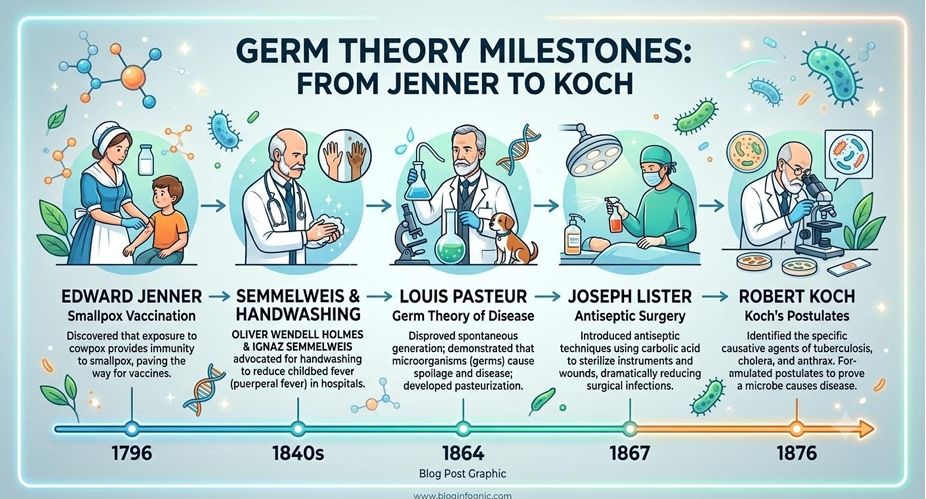
How Did a Vaccine Exist Before Anyone Understood Germs?
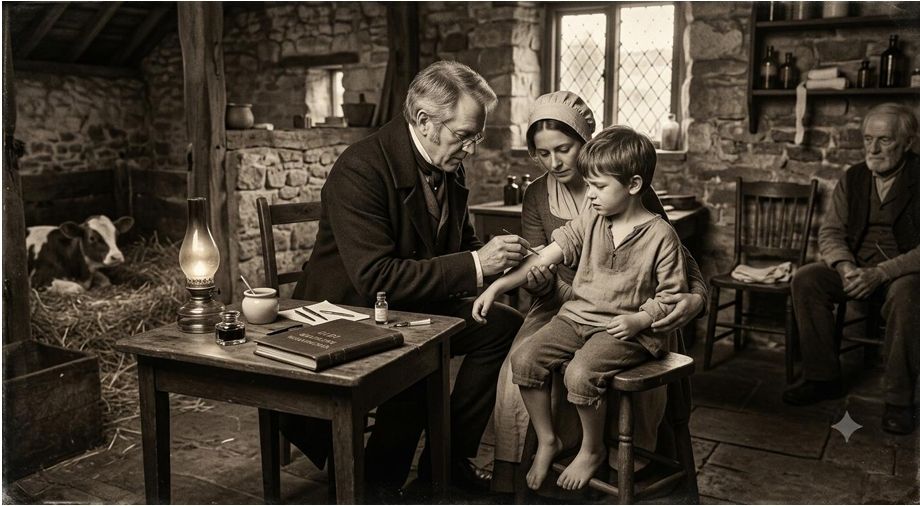
In 1796, English physician Edward Jenner observed that dairymaids who had contracted
cowpox seemed protected from smallpox, one of the era's deadliest diseases. He tested the
idea by inoculating a boy, James Phipps, with material from a cowpox sore; the boy developed
a mild bout of cowpox and recovered. Jenner then deliberately exposed him to smallpox —
and he did not develop the disease. That two-step result, cowpox first and a smallpox
challenge second, was the proof. Jenner had discovered a form of vaccination, roughly
seventy years before anyone could explain the mechanism behind it.
This is worth sitting with: the practice worked long before the theory existed to justify it. Jenner's method spread across Europe within years, driven entirely by observed results rather than any understanding of microorganisms. That gap between "it works" and "here is why" would not close until the 1860s.
This is worth sitting with: the practice worked long before the theory existed to justify it. Jenner's method spread across Europe within years, driven entirely by observed results rather than any understanding of microorganisms. That gap between "it works" and "here is why" would not close until the 1860s.
Source: DPMA, "Pasteur, Jenner and Vaccines" (German Patent and Trade Mark Office); History of
Vaccines, Vaccine Timeline (College of Physicians of Philadelphia)”
What Was Miasma Theory, and Why Did It Dominate for So Long?
For most of recorded history, disease was blamed on the term "miasma”; bad air rising from
decaying matter, swamps, and filth. It was not an unreasonable theory for its time: outbreaks
did cluster around poor sanitation, so a link between foul air and illness seemed convincing.
Miasma theory shaped public health responses for centuries, right through to the cholera
outbreaks of the 1850s.
The theory's real weakness was that it treated environmental factors as the cause rather than as a carrier. It could not explain why handwashing mattered, why some people caught a disease while others in the same "bad air" did not, or why an invisible agent might pass directly from one person to another. Replacing it required both better instruments and better evidence.
The theory's real weakness was that it treated environmental factors as the cause rather than as a carrier. It could not explain why handwashing mattered, why some people caught a disease while others in the same "bad air" did not, or why an invisible agent might pass directly from one person to another. Replacing it required both better instruments and better evidence.
Source: Encyclopedia.com, "The Germ Theory" (2024 update); Anatomy Note, "The Evolution of Germ
Theory: A Landmark Timeline in Medical History"
How Did Louis Pasteur Support the Theory that Germs Cause Disease?
Louis Pasteur's breakthrough began in the wine and beer industry, not in healthcare. In 1862,
investigating why fermentation sometimes soured, he demonstrated that airborne
microorganisms were involved, rather than spontaneous chemical change. By 1864, he had
formalised this into "germ theory": specific microscopic organisms cause specific diseases and
can spread between people, on surfaces, and in food.
This was a direct challenge to miasma theory, and it did not win acceptance overnight. Pasteur had to repeatedly and publicly demonstrate that sterilised broth remained free of microbial growth, whereas broth exposed to open air did not. Each demonstration chipped away at the idea that disease arose from bad air or spontaneous generation.
This was a direct challenge to miasma theory, and it did not win acceptance overnight. Pasteur had to repeatedly and publicly demonstrate that sterilised broth remained free of microbial growth, whereas broth exposed to open air did not. Each demonstration chipped away at the idea that disease arose from bad air or spontaneous generation.
Source: Britannica, "Louis Pasteur: Vaccine Development"; NCBI, "Vaccines Through Centuries: Major
Cornerstones of Global Health" (2015)
What Did Robert Koch Contribute to the Story?
If Pasteur established that germs cause disease in general, Robert Koch proved which germ
caused which disease. In 1876, he identified the bacterium responsible for anthrax, and in
1882 he isolated the bacillus responsible for tuberculosis. At that time, tuberculosis was
infecting roughly one in seven people in Europe.
Koch's real contribution to infection prevention was methodological. He developed a set of criteria, now known as Koch's postulates, to prove that a particular microbe causes a particular disease: it must be present in every case, isolated and grown in pure culture, capable of reproducing the disease when introduced into a healthy host, and re-isolated from that host afterwards. This gave germ theory the scientific rigour it needed to move from a compelling idea to a fact.
Koch's real contribution to infection prevention was methodological. He developed a set of criteria, now known as Koch's postulates, to prove that a particular microbe causes a particular disease: it must be present in every case, isolated and grown in pure culture, capable of reproducing the disease when introduced into a healthy host, and re-isolated from that host afterwards. This gave germ theory the scientific rigour it needed to move from a compelling idea to a fact.
Source: NCBI, "Vaccines Through Centuries" (2015); History of Vaccines, Vaccine Timeline

How Did Pasteur Turn Theory into Vaccination?
Once germ theory was established, Pasteur set out to apply it deliberately, rather than by
accident as Jenner had. In 1879, working with chicken cholera, he noticed that a weakened, or
"attenuated", culture of the bacteria protected the chickens from the full-strength disease. He
immediately recognised the connection to Jenner's work and coined the term "vaccine" in
tribute to Jenner's use of cowpox (“vacca” is Latin for cow).
Pasteur then applied the same attenuation principle to other diseases, developing an anthrax vaccine in 1881 and, most famously, a rabies vaccine in 1885. The rabies vaccine was first tested in animals and then, unexpectedly and urgently, on a nine-year-old boy bitten by a rabid dog. The boy survived. For the first time, vaccination was no longer a lucky observation; it was a repeatable, engineered process grounded in an understanding of the pathogen.
Pasteur then applied the same attenuation principle to other diseases, developing an anthrax vaccine in 1881 and, most famously, a rabies vaccine in 1885. The rabies vaccine was first tested in animals and then, unexpectedly and urgently, on a nine-year-old boy bitten by a rabid dog. The boy survived. For the first time, vaccination was no longer a lucky observation; it was a repeatable, engineered process grounded in an understanding of the pathogen.
Source: DPMA, "Pasteur, Jenner and Vaccines"; Britannica, "Louis Pasteur: Vaccine Development"
Why Do Semmelweis and Lister Belong in This Story?
Germ theory not only produced vaccines; it also transformed everyday clinical practice, often
ahead of the science that would later justify it. In 1847, Hungarian obstetrician Ignaz
Semmelweis observed that maternity wards staffed by doctors who also performed autopsies
had far higher death rates from childbed fever than those run by midwives alone. He
introduced handwashing with chlorinated lime before deliveries, and mortality fell sharply.
Semmelweis could not explain why this worked, as germ theory was still years away, and his peers largely rejected his ideas. He died in 1865, the same decade in which Pasteur's work began to vindicate him. Two years later, in 1867, English surgeon Joseph Lister, working at the Glasgow Royal Infirmary, applied germ theory directly, introducing carbolic acid as a surgical antiseptic, dramatically reducing post-operative infection rates in his patients. Lister's work accelerated the adoption of antiseptic and later aseptic practices, which gradually became standard surgical practice over subsequent decades.
Semmelweis could not explain why this worked, as germ theory was still years away, and his peers largely rejected his ideas. He died in 1865, the same decade in which Pasteur's work began to vindicate him. Two years later, in 1867, English surgeon Joseph Lister, working at the Glasgow Royal Infirmary, applied germ theory directly, introducing carbolic acid as a surgical antiseptic, dramatically reducing post-operative infection rates in his patients. Lister's work accelerated the adoption of antiseptic and later aseptic practices, which gradually became standard surgical practice over subsequent decades.
Source: Wiley Online Library, "Semmelweis: His Fight for Hand Hygiene" (2022); News-Medical, "History
of Asepsis"
Why Does This History Matter for Infection Prevention Today?
Every routine in modern infection prevention - hand hygiene, sterile technique, vaccination
schedules, outbreak investigation - traces back to this hundred-year arc from Jenner to Lister.
It is a reminder that good practice can precede full understanding, that evidence eventually
displaces even deeply held theories, and that the people who first proposed these ideas often
faced real resistance before they were proven right.
For anyone working in infection prevention today, it is worth remembering that the field's founders were still arguing over first principles less than two centuries ago. What we now teach as routine was, in living memory, a genuine scientific revolution.
For anyone working in infection prevention today, it is worth remembering that the field's founders were still arguing over first principles less than two centuries ago. What we now teach as routine was, in living memory, a genuine scientific revolution.
Why This Matters for IPC Staff Today
The principles established by Jenner, Pasteur, Koch, Semmelweis, and Lister remain visible in
every aspect of modern infection prevention practice:
- Vaccination programs are built on Jenner's observations and Pasteur's scientific framework.
- Infection surveillance relies on Koch's demonstration that specific pathogens cause specific diseases.
- Hand hygiene programs trace directly back to Semmelweis's observations on disease transmission.
- Aseptic technique, environmental cleaning, sterilisation, and transmission-based
precautions evolved from Lister's application of germ theory to patient care.
For IPC Leads in aged care, understanding this history reinforces why evidence-based
practice remains central to protecting residents, staff, and visitors.
Take Home Message:
Modern infection prevention did not emerge from a
single discovery. It developed through a series of
breakthroughs that connected observation, science,
and practice. Jenner showed prevention was
possible. Pasteur and Koch explained why.
Semmelweis and Lister demonstrated how that
knowledge could save lives. Every vaccine
administered, every hand hygiene audit completed,
and every outbreak investigated today reflects this
scientific legacy.
Our blogs are available on the IPS website, the HUB. All are produced so you don’t have to do the research. Let us know if you would like to read about another topic.
We post on social media – LinkedIn, Facebook and Instagram. Be sure to check these out.
For that gnarly question, try EVE first – she’s a multilingual chatbot and has access to all of our website information, not random internet posts.
Contact us directly at support@infectioncontrol.care
Lyndon Forrest
Managing Director | CEO
Lyndon is the Managing Director of Infection Prevention Services (IPS), bringing over 30 years' experience supporting aged care providers across Australia and New Zealand.
With a background spanning outbreak response, compliance, and infection risk management — alongside hands-on experience leading teams, managing multi-site operations, and navigating business turnaround — he understands both the clinical and organisational pressures aged care providers face. Lyndon holds a Master of Commerce (Industrial Relations), and applies that foundation to the people, process, and growth challenges that come with running a complex healthcare services business.
He is passionate about building the systems and capability that make infection prevention sustainable — not just compliant — and about helping organisations grow their confidence alongside their practice.
Lyndon's focus is straightforward: strengthen operations, develop the right people, and drive proactive infection prevention strategies that protect residents, staff, and communities for the long term.
Lyndon is the Managing Director of Infection Prevention Services (IPS), bringing over 30 years' experience supporting aged care providers across Australia and New Zealand.
With a background spanning outbreak response, compliance, and infection risk management — alongside hands-on experience leading teams, managing multi-site operations, and navigating business turnaround — he understands both the clinical and organisational pressures aged care providers face. Lyndon holds a Master of Commerce (Industrial Relations), and applies that foundation to the people, process, and growth challenges that come with running a complex healthcare services business.
He is passionate about building the systems and capability that make infection prevention sustainable — not just compliant — and about helping organisations grow their confidence alongside their practice.
Lyndon's focus is straightforward: strengthen operations, develop the right people, and drive proactive infection prevention strategies that protect residents, staff, and communities for the long term.
Erica Callaghan
Marketing Manager
Erica Callaghan is a dedicated professional with a rich background in agriculture and nutrient management. Growing up on her family's farm in Mid Canterbury, she developed a deep passion for farming. She currently resides on her partner's arable property in South Canterbury.
In 2017, Erica joined the Farm Sustainability team, focusing on nutrient management and environmental stewardship. In February 2024, she became the Manager of Marketing and Sales at Bug Control New Zealand - Infection Prevention Services, where her passion now includes improving infection prevention outcomes.
Outside of work, Erica loves cooking and traveling, often combining her culinary interests with her explorations in Italy and Vietnam. She enjoys entertaining family and friends and remains actively involved in farm activities, especially during harvest season.
Erica Callaghan is a dedicated professional with a rich background in agriculture and nutrient management. Growing up on her family's farm in Mid Canterbury, she developed a deep passion for farming. She currently resides on her partner's arable property in South Canterbury.
In 2017, Erica joined the Farm Sustainability team, focusing on nutrient management and environmental stewardship. In February 2024, she became the Manager of Marketing and Sales at Bug Control New Zealand - Infection Prevention Services, where her passion now includes improving infection prevention outcomes.
Outside of work, Erica loves cooking and traveling, often combining her culinary interests with her explorations in Italy and Vietnam. She enjoys entertaining family and friends and remains actively involved in farm activities, especially during harvest season.
Toni Sherriff
Clinical Nurse Specialist
Toni is a Registered Nurse with extensive experience in Infection Prevention and Control. Her career began as a kitchen hand and caregiver in Aged Care facilities, followed by earning a Bachelor of Nursing.
Toni has significant experience, having worked in Brisbane’s Infectious Diseases ward before returning home to New Zealand, where she continued her career as a Clinical Nurse Specialist in Infection Prevention and Control within Te Whatu Ora (Health NZ).
Toni brings her expertise and dedication to our team, which is instrumental in providing top-tier infection prevention solutions to our clients.
Toni is a Registered Nurse with extensive experience in Infection Prevention and Control. Her career began as a kitchen hand and caregiver in Aged Care facilities, followed by earning a Bachelor of Nursing.
Toni has significant experience, having worked in Brisbane’s Infectious Diseases ward before returning home to New Zealand, where she continued her career as a Clinical Nurse Specialist in Infection Prevention and Control within Te Whatu Ora (Health NZ).
Toni brings her expertise and dedication to our team, which is instrumental in providing top-tier infection prevention solutions to our clients.
Julie Hadfield
Accounts & Payroll
Julie is experienced in Accounts & Payroll Administration & after a long career in both the Financial & Local Government Sectors, is now working with our team. Julie brings her strong time management & organisational skills to our team, which is important to keep the company running in the background to enable the rest of our team to provide top notch service to all of our clients.
Julie is experienced in Accounts & Payroll Administration & after a long career in both the Financial & Local Government Sectors, is now working with our team. Julie brings her strong time management & organisational skills to our team, which is important to keep the company running in the background to enable the rest of our team to provide top notch service to all of our clients.
Andrea Murray
Content Editor
I attended Otago University in NZ and graduated as a Dental Surgeon. After 40 years in the profession, I retired in 2022. Infection prevention knowledge was part of everyday practice, dealing with sterilisation, hand hygiene, and cleaning.
Before retiring, I began doing some editing and proofreading for Bug Control as I am interested in the subject and in the English language. During the COVID-19 lockdown, I attended the ACIPC course "Introduction to Infection Prevention and Control", which increased my interest in the subject. I now work part-time as the Content Editor for the company.
I attended Otago University in NZ and graduated as a Dental Surgeon. After 40 years in the profession, I retired in 2022. Infection prevention knowledge was part of everyday practice, dealing with sterilisation, hand hygiene, and cleaning.
Before retiring, I began doing some editing and proofreading for Bug Control as I am interested in the subject and in the English language. During the COVID-19 lockdown, I attended the ACIPC course "Introduction to Infection Prevention and Control", which increased my interest in the subject. I now work part-time as the Content Editor for the company.
Personally, I lived in the UK for 10 years. My two children were born in Scotland, and now both are living in Europe, one in Amsterdam, Netherlands, and the other in Edinburgh, Scotland. I live close to Fairlie on the South Island of NZ, a beautiful part of the country, and I love being out of the city.
Princess
Customer Support
Princess began her career as a dedicated Customer Service Representative, honing her communication and problem-solving skills. She later transitioned into a Literary Specialist role, where she developed a keen eye for detail. Her journey then led her to a Sales Specialist position, where she excelled in client relations.
Now, as a Customer Support professional in Infection Prevention Services. Princess focuses on ensuring customer satisfaction, building loyalty, and enhancing the overall customer journey.
Princess began her career as a dedicated Customer Service Representative, honing her communication and problem-solving skills. She later transitioned into a Literary Specialist role, where she developed a keen eye for detail. Her journey then led her to a Sales Specialist position, where she excelled in client relations.
Now, as a Customer Support professional in Infection Prevention Services. Princess focuses on ensuring customer satisfaction, building loyalty, and enhancing the overall customer journey.
Dianne Newey
Senior Infection Prevention and Control Consultant
Dianne is a Senior Clinical Consultant at Infection Prevention Services (IPS), bringing over 35 years of nursing experience and a depth of clinical knowledge that most people would need two careers to accumulate.
Having served as Clinical Director at Royal Ryde Rehabilitation Hospital alongside a career spanning the full breadth of clinical practice, Dianne has seen it all — and more importantly, knows exactly what to do about it. She is the person in the room that everyone quietly hopes will speak first.
For more than seven years she has been a cornerstone of the IPS team, providing clinical advice, developing and reviewing policies and procedures, delivering monthly IPC webinars to IP Leads, and conducting environmental audits in aged care facilities across Australia and New Zealand. If infection prevention has a question, Dianne almost certainly has the answer — and she'll deliver it with a laugh that you'll hear from the other end of the corridor.
A true fountain of knowledge, wrapped in the kind of warmth and humour that only three decades of nursing can produce. Customers don't just trust Dianne — they look forward to hearing from her.
Dianne is a Senior Clinical Consultant at Infection Prevention Services (IPS), bringing over 35 years of nursing experience and a depth of clinical knowledge that most people would need two careers to accumulate.
Having served as Clinical Director at Royal Ryde Rehabilitation Hospital alongside a career spanning the full breadth of clinical practice, Dianne has seen it all — and more importantly, knows exactly what to do about it. She is the person in the room that everyone quietly hopes will speak first.
For more than seven years she has been a cornerstone of the IPS team, providing clinical advice, developing and reviewing policies and procedures, delivering monthly IPC webinars to IP Leads, and conducting environmental audits in aged care facilities across Australia and New Zealand. If infection prevention has a question, Dianne almost certainly has the answer — and she'll deliver it with a laugh that you'll hear from the other end of the corridor.
A true fountain of knowledge, wrapped in the kind of warmth and humour that only three decades of nursing can produce. Customers don't just trust Dianne — they look forward to hearing from her.
Caoimhe (Keva) Stewart
Clinical & Business Operations Manager
Caoimhe is the Clinical & Business Operations Manager at Infection Prevention Services (IPS), bringing a clinical background as a Registered Nurse across the UK and Australia — and an almost unsettling ability to make technology do exactly what she wants.
With experience in Occupational Health, Palliative Care, and Community Nursing, she understands the real challenges faced by healthcare teams. What she may lack in stature she more than makes up for in impact — Caoimhe is the kind of person who walks into a problem, sizes it up, and has three solutions before anyone else has finished reading the brief.
Customers love her. Not just because she delivers — though she always does — but because she genuinely cares about the outcome on the other side. She is passionate about creating seamless learning experiences and empowering organisations with the tools, knowledge, and support needed to strengthen infection prevention practices and improve care outcomes.
Small in size. Mighty in results. Completely irreplaceable.
Caoimhe is the Clinical & Business Operations Manager at Infection Prevention Services (IPS), bringing a clinical background as a Registered Nurse across the UK and Australia — and an almost unsettling ability to make technology do exactly what she wants.
With experience in Occupational Health, Palliative Care, and Community Nursing, she understands the real challenges faced by healthcare teams. What she may lack in stature she more than makes up for in impact — Caoimhe is the kind of person who walks into a problem, sizes it up, and has three solutions before anyone else has finished reading the brief.
Customers love her. Not just because she delivers — though she always does — but because she genuinely cares about the outcome on the other side. She is passionate about creating seamless learning experiences and empowering organisations with the tools, knowledge, and support needed to strengthen infection prevention practices and improve care outcomes.
Small in size. Mighty in results. Completely irreplaceable.
Bridgette Mackie
Clinical Nurse Educator
Bridgette is an experienced New Zealand Registered Nurse, qualified Healthcare Auditor, and Healthcare Educator with a strong background in clinical quality, competency assessment, and infection prevention. She has led large-scale OSCE and CAP training programmes for internationally qualified nurses, developed sector-specific educational resources, and coordinated HealthCERT audit preparation in the surgical sector.
Known for her engaging teaching style and genuine passion for supporting learners, Bridgette excels at making complex topics accessible and relevant. She blends operational leadership with a deep commitment to professional development and safe, effective practice.
Bridgette is an experienced New Zealand Registered Nurse, qualified Healthcare Auditor, and Healthcare Educator with a strong background in clinical quality, competency assessment, and infection prevention. She has led large-scale OSCE and CAP training programmes for internationally qualified nurses, developed sector-specific educational resources, and coordinated HealthCERT audit preparation in the surgical sector.
Known for her engaging teaching style and genuine passion for supporting learners, Bridgette excels at making complex topics accessible and relevant. She blends operational leadership with a deep commitment to professional development and safe, effective practice.